April 15, 2026
Your front desk is the slowest part of your guest's day. A guest who has already filled in a booking form, paid a deposit, and uploaded a passport scan is asked to do most of it again at a counter - while you pay a clerk to retype it. Contactless check-in fixes that.
This is the 2026 buyer's guide to contactless check-in solutions for hotels. We explain what it is, how the guest journey actually works, how mobile and kiosk formats compare, what digital keys look like now that mobile wallets are mainstream, the five vendors most US hotels evaluate, what it costs, and the buyer's checklist you should walk into your next vendor call with.
A contactless check-in hotel system lets a guest move from booking to bedroom without touching a counter, a keycard, or a paper form.
Hotel contactless check-in usually combines three things - pre-arrival document upload, digital payment authorization, and a digital room key - delivered through a mobile app, a self-service kiosk, or both.
The point is not just hygiene. The point is that everything the front desk used to do - verify identity, run a deposit, hand over a key, explain the WiFi - is now data the guest has already entered, ready to be confirmed in seconds. Your staff spends less time as a typist and more time as a host.
Adoption is no longer driven by the pandemic. It is driven by guest expectation.
Five operational benefits show up consistently in the properties that have rolled this out at scale.
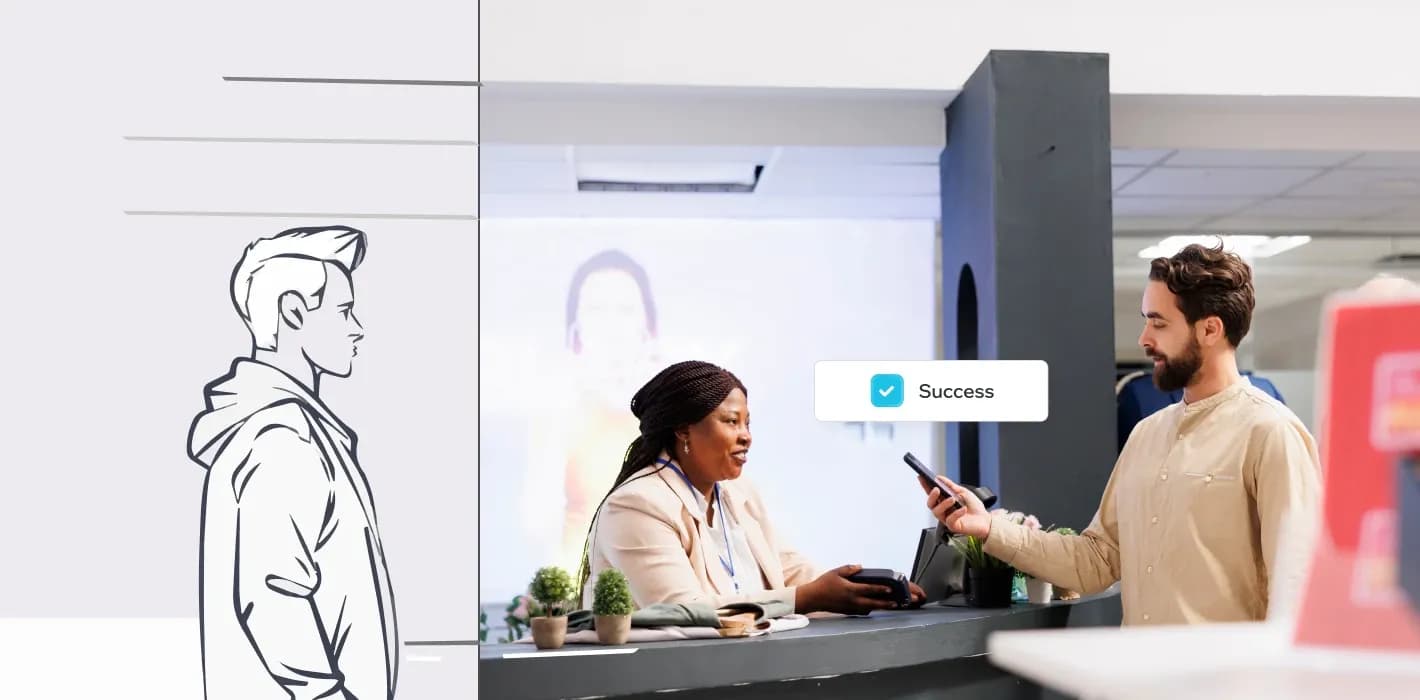
Wait times are the single biggest source of arrival friction at city hotels with peak check-in windows. Contactless check-in removes the queue. Guests confirm their details from the airport or the curb, receive a room number and a key on their phone, and skip straight to the elevator. The first interaction with your brand becomes a smooth one - not a fifteen-minute line behind a tour group.
A 2026 Mews survey found that 70% of travelers would now skip the front desk entirely if they could, with the figure climbing to 82% among Gen Z. For hotel operations, that translates directly into staffing relief. Front-desk colleagues are freed from typing and identity checks to focus on the conversations that build loyalty: recommendations, recovery, upsell. The work shifts from clerical to hospitable.
Digital check-in flows verify a guest's ID document against a live selfie before the digital key is issued. That is a stronger check than a clerk glancing at a driver's license at the counter. The audit trail is also better - every check-in produces a timestamped record of which document was used and when. Fewer disputes, cleaner compliance.
The economic case is straightforward. You retire most of the labor cost of manual check-in, you reduce the number of plastic keycards you replace each month, and you shorten the staff time spent on payment reconciliation. Hospitality industry analysts tracking contactless adoption in 2026 consistently report meaningful payback inside the first year for mid-size properties.
Contactless check-in is no longer a differentiator. It is a baseline expectation, especially for business travelers and the under-40 leisure segment. The advantage now belongs to the hotel that does it well - fast, multilingual, and integrated with the room experience the guest walks into. The disadvantage belongs to the hotel that does not offer it at all.
Contactless check-in works in five steps, from the guest's perspective. Each step is automated, but each leaves the guest in control.
The whole flow takes a guest about two minutes. It replaces a process that, at peak, can take twenty.
Contactless check-in is not one format. It is three, and the right one depends on your property's guest mix and physical footprint.
| Format | Capex | Staff requirement | Guest age skew | Best-fit property types | Common failure mode |
|---|---|---|---|---|---|
| Mobile-only | Low | Lowest | Skews younger | Limited-service, select-service, branded chains | International guests who refuse to download a branded app |
| Kiosk-only | High (hardware) | Low at arrival | Even spread | Airport hotels, large independents, conference hotels | Hardware downtime; queues during peak check-in times |
| Hybrid (mobile + kiosk + manned desk) | Highest | Moderate | All segments | Full-service and luxury hotels | Operational complexity — staff must master all three |
Mobile-only is the lowest cost and fastest to deploy. It works well for branded properties whose guests already have the brand's guest app on their phone. Kiosk-only is the safer choice when a meaningful share of your guests are international, app-averse, or simply prefer not to download anything for a two-night stay. Hybrid is the only honest answer for full-service properties where some guests want speed and others want a person.
The digital key is the part of the flow that most often breaks, and it is where most of the 2026 innovation has happened. Three approaches dominate.
The native vendor app remains the most common - the guest downloads the brand or vendor app, and the key lives inside it. It is the most flexible approach, but it depends on the guest installing software for a short stay.
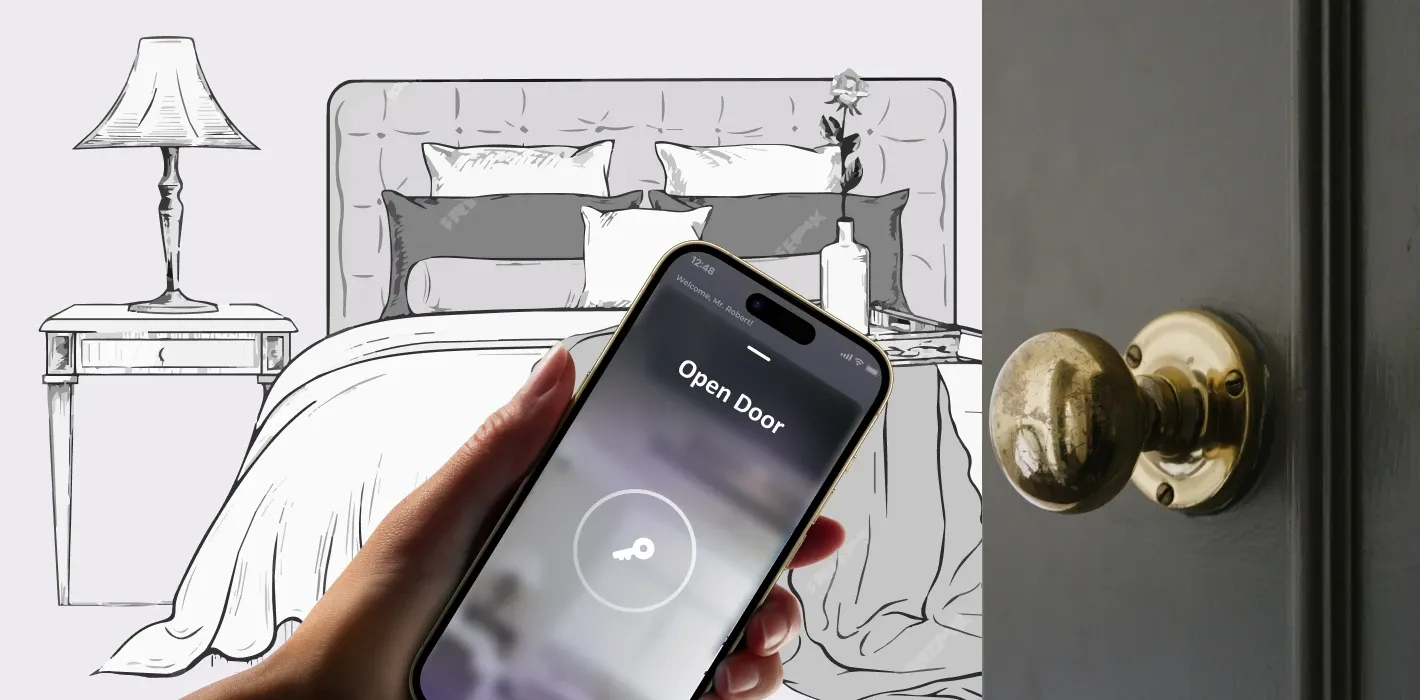
Apple Wallet and Google Wallet hotel keys are now the second approach, and they are the one growing fastest. The guest does not download anything. The key arrives as a wallet pass, the way an airline boarding pass does, and the phone unlocks the door over NFC. Wallet-based keys have moved from chain pilots into mainstream independent adoption in 2026.
BLE and NFC physical-card hybrids are the third approach. A Bluetooth or NFC sticker pairs the phone with the lock during the stay, with a fallback plastic card issued at the desk if anything fails. This is the most conservative choice and the one most large chains run as their failover layer.
The binding constraint is rarely the software. It is the lock hardware itself. Confirm compatibility with your existing locks - Salto, Assa Abloy, Dormakaba, Onity - before you choose a check-in vendor. Retrofitting locks costs more than the check-in software does.
A recurring discussion across hotel forums and guest communities raises a question most vendor pages skip: if a guest checks in entirely on their phone, who verifies that they are old enough to stay in a room with a minibar, or to use a property bar tied to their room key? It is a real concern at properties with casinos, bars, and minimum-age policies.
The honest answer is that the verification is stronger, not weaker, when the flow is digital. The system reads the date of birth straight from the scanned ID, matches it against the live selfie, and gates the digital key behind the result. A guest who fails the age check cannot receive a key in the first place. The audit trail is also stronger than a paper signature.
Two operational rules sit on top of this. First, your contactless flow must comply with the local privacy regime - GDPR for European guests, CCPA for California guests - which means the ID image is encrypted in transit, retained only as long as the law allows, and deleted on schedule. Second, you need a clean fallback for documents the system cannot read. A blurred photo, a foreign passport with an old MRZ format, or a damaged ID should route the guest to a colleague - not into a dead end.
Five vendors come up consistently in US hotel evaluations in 2026. The right choice depends on your PMS, your property type, and how much of the flow you want to own.
| Vendor | Format strength | Best-fit property type | Typical PMS integrations | Digital key support | Notable extras |
|---|---|---|---|---|---|
| Canary Technologies | Mobile-first | Branded chains, select-service | Opera, Mews, Cloudbeds | Native app + wallet | Digital authorizations, upsells |
| Mews | PMS-native | Properties using Mews PMS | Mews (native) | Native app + wallet | Strong adoption analytics |
| Operto | Kiosk + smart-lock | Independents, serviced apartments | Mews, Cloudbeds, RMS | Native + smart-lock | Deep smart-lock integration |
| Duve | Mobile-first | Boutique and mid-scale hotels | Opera, Mews, Cloudbeds, Apaleo | Native app + wallet | Strong upselling and document collection |
| Virdee | Kiosk-led | Airport hotels, large independents | Opera, Mews, Stayntouch | Native + wallet | Video assistance + kiosk hardware |
Canary Technologies leads on speed of rollout for branded chains and select-service properties. The platform handles pre-arrival check-in, digital authorizations, and upsell prompts in a single flow.
Mews is the obvious choice if you already run Mews PMS. The Mews Kiosk and Guest Portal are the same product family as the back office, which removes the integration risk that often slows independent rollouts.
Operto is built around smart locks first and check-in second. That order matters if you operate serviced apartments or vacation rentals where lock control is the harder problem.
Duve sits in the boutique and mid-scale segment. Its strength is the document-collection and upsell flow - properties that lean on ancillary revenue tend to do well with it.
Virdee is the kiosk-led option, with proprietary hardware and a strong video-assist feature for guests who want a remote human at the kiosk rather than no human at all. It is the natural fit for airport hotels and large independents.
The shortlist deliberately excludes pure marketing platforms and AI-only guest messaging tools. Both categories are adjacent to contactless check-in but should not be confused with it when you scope a vendor evaluation.
Pricing falls into three patterns. The first is per-room SaaS, typically two to ten dollars per room per month for the software, scaled by property size. The second is per-stay transaction pricing, common with vendors who bundle ID verification with payment authorization. The third is a flat platform fee plus a one-time setup cost, more common with kiosk-led vendors who sell hardware.
Kiosk hardware itself runs from roughly fifteen hundred dollars for a tabletop unit to eight thousand or more for a floor-standing kiosk with a passport scanner, document printer, and card encoder. Most properties recover the hardware within twelve to eighteen months through labor offset.
The hidden costs are the ones most evaluations miss. PMS integration fees from your PMS vendor can rival the contactless software cost in year one. Lock hardware retrofit, if your existing locks are not Bluetooth-ready, runs from one to four hundred dollars per door. Staff training, multilingual content localization, and per-scan ID-verification fees all add up.
The ROI math runs in the other direction. The labor offset is the obvious gain. The less obvious gain is upsell. Mews data shows guests who check in via kiosk are roughly three times more likely to accept an upsell than guests who check in at the front desk. For a 150-key property, that upsell uplift alone often covers the platform fee.
A guest who has skipped the front desk arrives in their room with no human introduction to your property. The in-room television is the next touchpoint, and the one that decides whether the contactless impression was efficient or simply cold.
Hospitality TV solutions running on a smart-room platform can pick up where the digital key left off - a personalized welcome screen with the guest's name, the WiFi password already paired, a service menu that knows about the late checkout the guest paid for, and one-tap access to F&B and local information. The contactless arrival becomes a contactless service experience for the rest of the stay.
This is the part of the contactless flow that most vendors skip. The check-in product ends at the door; the in-room entertainment system carries the conversation from there. Done well, the guest's first three minutes in the room reinforce everything the contactless flow promised on the way in.
Talk to us about connecting your contactless arrival to in-room engagement.
When you sit down with vendors, walk in with this list. Score every shortlisted product against it before you ask for pricing.
Any vendor that cannot answer all ten without hedging is not ready for production at your scale.
Contactless check-in is now a baseline expectation. The question is not whether to deploy it. It is which format fits your property, which vendor fits your PMS and locks, and what your guests see in the room once they have skipped the front desk. Get in touch with us - we can show you how smart-TV in-room experiences extend a contactless arrival into the full stay.
A guest receives a pre-arrival prompt, uploads an ID document and a selfie for verification, confirms payment, and receives a digital key on their phone - either inside a vendor app or in Apple or Google Wallet. They walk past the front desk and unlock the room directly with the phone.
Yes. The verification is typically stronger than a manual ID check at the desk, payment data is tokenized, and the audit trail is timestamped end-to-end. The risk that needs managing is privacy compliance - GDPR for European guests and CCPA for California guests - which dictates how ID images are stored and when they are deleted.
Contactless check-in is the broader category - the process of moving a guest from booking to room without staff contact. A self-service kiosk is one delivery method, alongside mobile-only and hybrid models. Most full-service hotels run a hybrid: mobile for repeat guests, kiosks for walk-ins, and a manned desk as a fallback.
Software typically runs two to ten dollars per room per month. Kiosk hardware ranges from roughly fifteen hundred to eight thousand dollars per unit. The hidden costs are PMS integration fees and any lock-hardware retrofit. Labor offset and upsell uplift usually cover the investment inside a year for mid-size properties.
In most cases, yes - but verify before you sign. Mainstream vendors integrate with Opera, Mews, Cloudbeds, RMS Cloud, and Stayntouch, and with Salto, Assa Abloy, Dormakaba, and Onity locks. Contactless check-in systems can also integrate with smart TVs, CRMs, and in-room entertainment systems, so the data captured at check-in flows through to the rest of the stay.

Content Writer
Anahit is a technical content writer and digital marketing specialist who focuses on B2B content about IPTV, multiplatform media, and digital technologies. She creates clear and engaging content about modern media technologies. Her goal is to help readers easily understand complex topics and stay informed about the latest innovations in digital media.