May 4, 2026
Manual data entry is how hotels lose money quietly. A reservation typed by hand into the PMS while the front desk handles a check-in is the moment a double booking begins - and by the time you notice, you're walking a guest at midnight and absorbing the review the next morning.
Hotel PMS integration is the connective tissue that prevents this. It links your property management system with your channel manager, OTAs, point of sale, CRM, and revenue tools so reservations, rates, availability, folios, and guest profiles move automatically between every system your team touches. This guide walks through how it works in 2026 - the architecture, the open APIs, the costs, the AI shift, and what to ask before you sign.
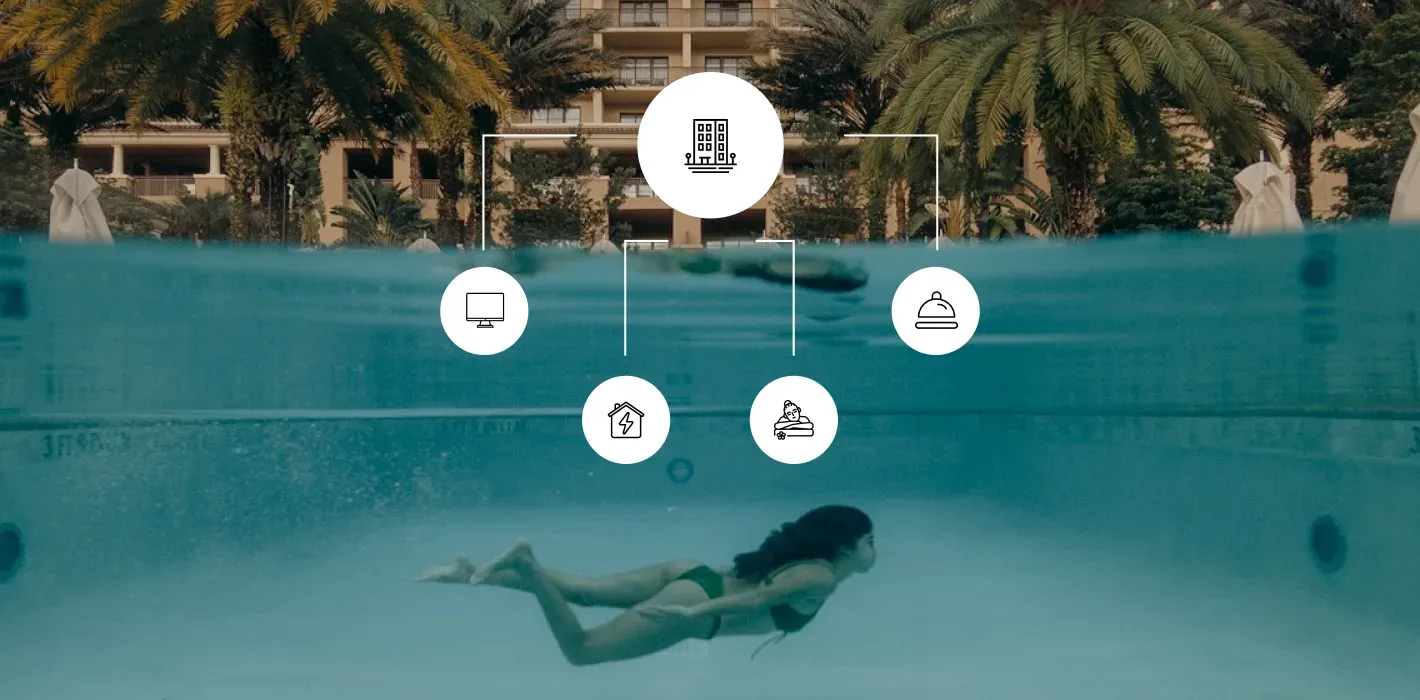
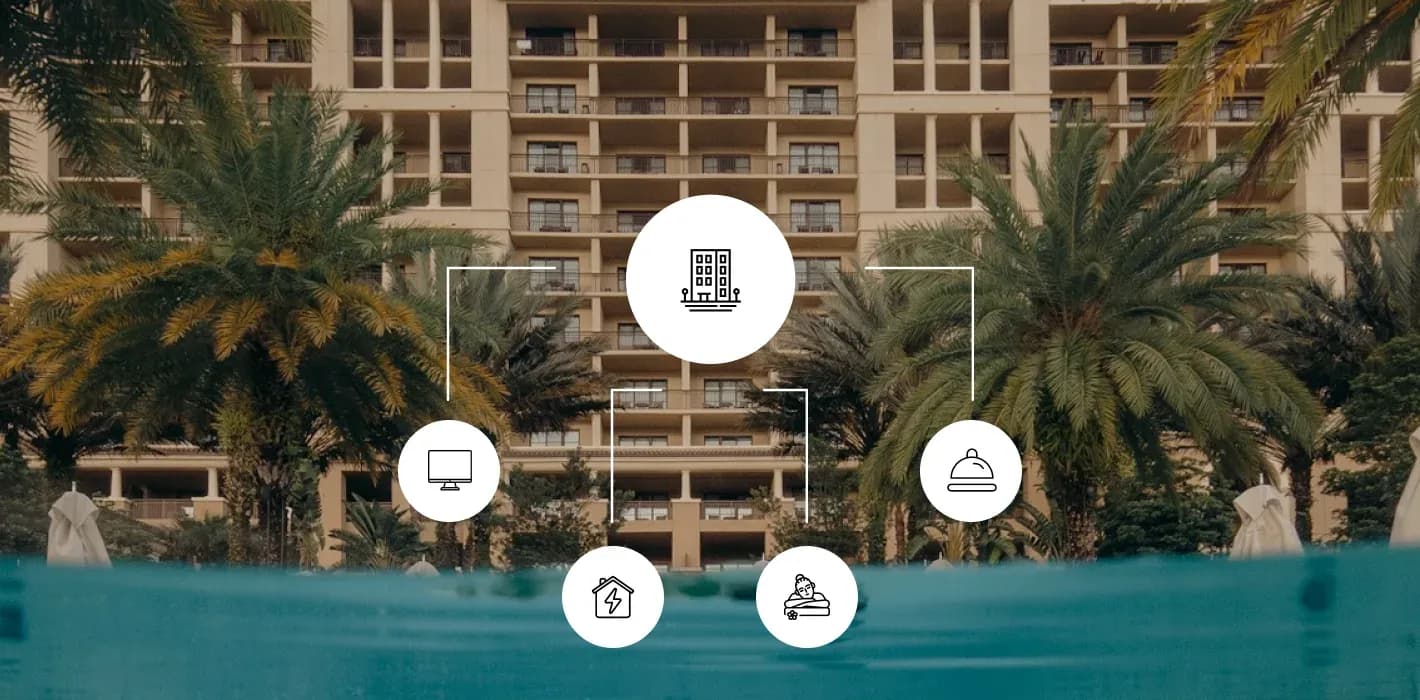
Hotel PMS integration is the process of connecting your property management system to the other software platforms that run your hotel - so they share data automatically, in real time, without your team retyping a single line.
Five data types move across the integration: reservations, rates, availability, folios, and guest profiles. When a guest books a room on Booking.com, the channel manager pushes the reservation into your PMS, the PMS updates room availability everywhere it's published, the POS knows which folio to charge the bar tab to, and the CRM updates the guest's stay history - all without anyone touching a keyboard.
This is the difference between a hotel that runs and a hotel that runs you ragged. Integration is also the foundation that newer capabilities - like hotel automation and AI-driven guest service - need before they can work at all.
Picture a single guest journey to see the integration in motion. A guest searches for a room on a metasearch site, clicks through to Booking.com, and reserves a king room with late check-in. Within seconds, the channel manager pushes that reservation into your PMS.
The PMS reduces availability across every connected channel (your direct site, Expedia, Airbnb) so the same room can't be sold twice. At check-in, the front desk sees the reservation, the late-arrival note, and the guest's loyalty profile pulled from the CRM. The guest charges a drink at the bar; the POS posts the charge to the room folio in the PMS. At checkout, the folio is settled in one transaction.
That is two-way (bidirectional) integration in action. Data moves both directions - booking in, charges out - and every system reflects the same truth.
The architecture detail behind this matters more than most hoteliers realize. Older integrations rely on polling: the channel manager checks the PMS every 5-15 minutes for changes. In a high-demand window, a 10-minute sync cycle is enough time to sell the same room twice. Modern integrations use webhooks - event-driven pushes that fire the moment a reservation is created, modified, or cancelled. The room is locked across all channels in seconds, not minutes.
One field-mapping note worth flagging: when two systems use different schemas, certain fields don't always survive the round trip. Guest comments, accessibility flags, dietary requirements, and late-arrival notes can get stripped between an OTA's booking form and your PMS. When you're evaluating an integration, ask which fields carry through end-to-end - not just whether the booking arrives.
A well-integrated PMS pays for itself in five operational outcomes.
Real-time sync across every distribution channel closes the gap that lets the same room sell twice. The faster the sync (webhook-based, ideally), the smaller the risk. For revenue managers running aggressive yield strategies, this is the difference between confidence and constant fire-fighting.
When the PMS exchanges guest profiles with your CRM, your front desk knows the guest's preferences before they walk in - preferred room type, allergies, anniversary, last stay. That intelligence travels into the in-room experience and into post-stay outreach. Guest-experience investments only pay back when the underlying data is clean and shared.
Front office, housekeeping, F&B, and maintenance all read from the same source of truth. Housekeeping sees check-out updates the second they happen. F&B charges post automatically to folios. Maintenance tickets close out in the PMS without a separate workflow. Less retyping, fewer reconciliations, fewer errors.
Integrated rate and availability data flows into your revenue management platform, which uses it to recommend pricing in real time based on demand, competitor pricing, and forecast occupancy. According to industry adoption data, hotels using integrated revenue management see meaningful lifts in RevPAR compared with properties running pricing decisions manually - verify the latest figures from a recognized source like Skift Research before publishing.
When data lives in one place, weekly performance reports take minutes instead of hours. ADR, occupancy, RevPAR, GOPPAR, and booking-pace data are accurate without manual stitching. Your team spends time on decisions, not on reconciling spreadsheets.
Here are the main types of systems that commonly integrate with a PMS:
| System Type | Examples | Key Benefits |
|---|---|---|
| Booking Engines | SiteMinder, Cloudbeds | - Maximizes direct bookings by integrating with your PMS. - Automatically syncs reservations in real-time, reducing manual updates and errors. - Provides accurate room availability, pricing, and special offers. - Reduces reliance on third-party channels and cuts commission costs. |
| Channel Managers | STAAH, Myallocator | - Connects your PMS with OTAs like Expedia, Booking.com, and Airbnb. - Updates room inventory across all platforms instantly, preventing overbookings. - Centralizes pricing and availability management from one dashboard. - Expands hotel reach, boosts occupancy, and increases revenue. |
| Customer Relationship Management (CRM) Systems | Revinate, Guestline CRM | - Gathers guest data to personalize experiences and communications. - Enables tailored marketing, loyalty programs, and personalized service. - Alerts staff about guest preferences, boosting satisfaction and repeat visits. - Enhances guest relationships and long-term loyalty. |
| Point-of-Sale (POS) Systems | Oracle MICROS, Lightspeed POS | - Integrates restaurant, bar, spa, and gift shop transactions with the PMS. - Links guest charges directly to their room for a seamless checkout. - Provides real-time sales and inventory tracking. - Reduces billing errors and improves operational efficiency. |
| Revenue Management Systems (RMS) | HotelSmarters | - Analyzes demand, occupancy, and market trends to adjust room pricing dynamically. - Optimizes pricing strategies with real-time data. - Improves forecasting and revenue potential. - Maximizes profitability with smarter, data-driven pricing decisions. |
Choosing the ideal PMS integration for your hotel can be a game-changer. But it all starts with understanding your unique needs, budget, and long-term goals.
Step 1: Evaluate Your Hotel’s Specific Demands
Large hotel chains benefit from RMS and channel managers for pricing optimization and multi-location coordination.
Smaller boutique hotels should focus on booking engines and CRM to enhance personalized guest services.
Step 2: Ensure Scalability and Ease of Use
Choose a PMS that meets current needs while being flexible enough to grow with your hotel. Look for solutions that adapt to emerging tech trends and guest demands.
Step 3: Verify Seamless Integration
Ensure the PMS works smoothly with existing systems like housekeeping and POS. The smooth transition across departments minimizes disruptions.
Step 4: Consider Customer Support and Updates
Opt for a provider that offers reliable support and regular software updates. Start comprehensive training to ensure your team is confident using the new system.
Step 5: Set Your Hotel Up for Future Growth
The correct PMS integration drives efficiency, enhances guest experience, and supports long-term success.
HotelSmarters will help you maintain, integrate, and innovate your hospitality business, so don’t waste time; contact us today.
Two architectural patterns dominate the market in 2026, and the choice affects every downstream decision.
In a hub-and-spoke model, the PMS is the hub. Every other system - channel manager, CRM, POS, revenue tool, guest app - connects to the PMS through a dedicated point integration. This is how most legacy stacks were built. It works, but it scales painfully: every new system means a new integration project, and every PMS upgrade puts every spoke at risk.
A unified platform runs distribution, payments, guest experience, and revenue on a single shared data layer. There's no spoke-by-spoke wiring because the systems were designed to read from the same model. This is what newer cloud-native PMS platforms have moved toward, and it's the foundation that makes AI-driven workflows readable across systems.
The strategic question for hotel owners and IT leads is no longer "what integrations does my PMS support" but "what does my data layer look like, and can my analytics and AI tools read across it cleanly."
API quality has become a buying criterion, not a footnote.
When you evaluate a PMS in 2026, the questions to ask are: Does it expose a documented REST API? Does it support webhooks for event-driven integrations? Is there a public developer portal? How many integration partners are already certified, and how active is the marketplace?
These questions used to be the IT lead's department. Now they're the GM's, because they directly determine which third-party tools you can plug in over the next five years without custom development.
A handful of platforms shape the conversation. Oracle OPERA Cloud publishes its integrations through the Oracle Hospitality Integration Platform (OHIP), with a marketplace approaching 1,200+ certified partners. Mews runs an open-API model with 800+ integrations. Cloudbeds offers an open integration framework. Apaleo has built its product around an API-first architecture from day one. Verify the current partner counts on each vendor's site or HotelTechReport before publishing.
The protocols you'll see most often are REST and webhooks for modern systems, and HTNG (Hotel Technology Next Generation) or SOAP for legacy ones. If your PMS still requires SOAP-only integrations, that's a signal worth weighing against the next platform you evaluate
The integration question in 2026 has shifted. It used to be: "Can your PMS talk to system X?" Now it's: "Can an AI agent read across all your integrated systems and act on behalf of the front desk?"
Three patterns are emerging. AI receptionists answer guest questions by querying PMS, CRM, and POS data simultaneously - "what time is breakfast and can I add it to my room?" gets a single, accurate answer because the agent reads across systems. Conversational AI handles reservation changes - guests modify dates, room types, or add amenities through chat, and the change writes back to the PMS automatically. Agentic upsell engines read guest history and reservation context to surface relevant offers at the right moment in the stay.
None of this works without a clean integration layer underneath. The buyer's question for 2026 is straightforward: does your PMS expose data to AI agents in a structured, queryable way?
This is also where guest-experience surfaces become AI consumers, not just AI sources. A connected hotel guest app, for example, can act as the conversational front end that reads across PMS folio data, CRM preferences, and live POS menus - but only if those systems are integrated to begin with.
Six steps separate a clean rollout from a painful one.
Map your existing stack. List every system your hotel runs - booking engine, channel manager, CRM, POS, RMS, payment gateway, guest-experience tools. Note which are critical and which are negotiable. Ask the vendor: which of these do you have certified integrations with today?
Prioritize two-way (and ideally webhook-based) integrations. One-way feeds are not enough for distribution. Ask the vendor: is the integration polling-based or webhook-based, and what's the typical sync latency under load?
Check the partner ecosystem and API quality. A vendor with 50 integrations is a different bet than one with 800. Ask the vendor: can I see your developer portal and your partner marketplace?
Verify field-mapping fidelity. Ask which fields carry end-to-end and which get stripped. Ask the vendor: what happens to guest comments, accessibility flags, and special requests when a booking flows from OTA to PMS?
Pressure-test compliance. Confirm the vendor's PCI-DSS v4.0 attestation and GDPR posture. Ask the vendor: show me your most recent attestation and your DPA template.
Ask who owns support when the integration breaks. This is the single most under-asked question in PMS procurement. If the channel manager points at the PMS and the PMS points at the channel manager, you're the one walking the guest at midnight. Ask the vendor: who is the named owner of integration support, and what is the SLA?
Need help thinking through which guest-experience and operations tools should sit on top of your PMS? Talk to HotelSmarters.
A realistic implementation timeline depends on the scope. A basic out-of-the-box integration to a modern cloud PMS takes 4-8 weeks. A full tech-stack overhaul with 5+ integrated systems takes 12-20 weeks.
The phases break down predictably:
Industry coverage from outlets like Hospitality Net tracks how implementation timelines are shifting as more PMS platforms move to true API-first architectures - worth a scan when you're scoping your own rollout.
Two regulations apply to almost every PMS integration project.
PCI-DSS v4.0 has been in force since March 2025. Every payment integration touched by your PMS - booking engine, OTA payment passthrough, POS, gateway - must now meet the new tokenization, audit-logging, and customized-approach requirements. Your PMS vendor and every integration partner that handles cardholder data needs a current Attestation of Compliance. Ask for it during procurement, not after. Full requirements are published by the PCI Security Standards Council.
GDPR still applies whenever a guest-data flow includes EU or UK residents. The integrated stack pattern - PMS to CRM to email tool to OTA - magnifies the compliance surface area. Cross-system data minimization, lawful basis for each data movement, and clear DPA terms with each integration partner are the load-bearing controls. Current guidance is published by the European Data Protection Board.
Compliance is not a side-quest. A breach involving an integrated guest-data flow is a breach involving every system the data touched.
HotelSmarters sits on top of your integrated PMS, not inside it. Once your PMS is exchanging clean data with your channel manager, OTAs, POS, and CRM, the next question is what runs in front of the guest - on their TV, their phone, the in-room tablet, the casting screen, the digital signage in the lobby.
That guest-experience layer is where HotelSmarters lives. Our interactive TV platform reads room number, guest language, and folio data from your PMS to personalize the in-room experience the moment a guest checks in. Our in-room tablets, guest app, casting solution, and digital signage all consume the data your integrated PMS distributes - and an integrated revenue management platform pairs PMS data with your forecast model to keep pricing decisions current.
If you're investing in PMS integration this year, plan the guest-experience layer in the same conversation. They depend on each other.
Once your PMS is integrated, the next question is what runs on top of it - guest experience, operations, revenue. That's the conversation worth having now, while the architecture is still on the whiteboard. Get in touch with us to talk through the stack, or explore the HotelSmarters platform to see what fits your property.
A Hotel Property Management System (PMS) is a software solution that helps hotels manage their daily operations, including reservations, guest check-ins and check-outs, room assignments, billing, and reporting.
Integrating a PMS with a revenue management system (RMS) allows for real-time price adjustments based on occupancy, competitor rates, and demand forecasts. This helps maximize revenue potential and prevent issues like overbooking, while also streamlining rate distribution across various platforms.
By connecting your PMS with CRM and mobile apps, you can offer personalized guest services such as room preferences, tailored promotions, and seamless check-in/check-out. Real-time data helps staff provide better, more efficient services, increasing guest satisfaction.
Choosing the right PMS integration depends on factors such as your hotel’s size, specific needs, and future growth plans. Larger hotels may need complex integrations like revenue management and channel managers, while smaller properties may focus on booking engines and CRM integration.
Choosing scalable solutions with strong customer support and software updates is important.
While the cost of PMS integration can vary depending on the complexity and scale, many systems offer customizable packages to suit different hotel sizes and needs. Some providers offer tiered pricing models or a pay-per-room fee. Requesting quotes from providers is advisable to understand the cost based on your hotel's needs.
The timeline for integrating a PMS can vary based on the integrated systems, the hotel's size, and the complexity of the setup. Typically, integrations can take anywhere from a few days to several weeks. Planning the process carefully and having support from the PMS provider is crucial to ensure a smooth transition.

Co-founder / CTO
Armen is the CTO and Co-Founder of inoRain OTT and Co-Founder of HotelSmarters, specializing in advanced streaming technologies, OTT strategy, and interactive TV systems. He builds scalable end-to-end video delivery solutions and drives technical innovation across hospitality and streaming platforms, bridging complex engineering with practical business impact.