August 16, 2026
You approved the budget. The screens went in. Six months later your front desk is still fielding calls about how to turn the television on.
That is the real risk in hotel technology trends for 2026. Not falling behind, but spending properly and getting nothing back. Your guests arrive with their own streaming subscriptions, their own devices and little patience for anything that needs instructions. Meanwhile every trade publication hands you thirty technologies and no way to rank them.
So which ones deserve your money? Below are ten trends shaping guest expectations, what each is worth at your property size, and where these projects fall apart.
Technology in the hotel industry has been called "the future" for so long the phrase stopped meaning anything. What changed is not the vocabulary. It is the money and the timelines.
Capital is moving at scale. Hospitality technology startups raised $1 billion across 40 companies between April 2025 and March 2026, led by property management systems at $408.1 million. That funding reaches your desk as sales pressure within about eighteen months.
AI stopped being an experiment. 85% of hospitality IT decision-makers say they will put more than 5% of their IT budget into AI this year, and 58% will commit more than 10%. Just over half are already running something live.
And the replacement cycle has arrived. 51% of hotel professionals plan to replace or upgrade their stack within twelve to twenty-four months, and their biggest concern is integration, named by 38%. That detail matters. The industry's real anxiety in 2026 is not choosing the wrong product. It is owning several right products that refuse to talk to each other.
Technology trends in the hotel industry get presented as a flat list, as though every item carried equal weight. They do not. Some of the new hotel technology trends below are already expected, some will separate you from the property across the street, and one or two are worth watching rather than buying.
For years the AI story in hospitality was a chatbot answering questions about pool hours. That is table stakes now. The interest today is in systems that complete a task rather than describe one - rebooking a guest whose flight slipped, chasing an unconfirmed reservation, reconciling a rate discrepancy overnight. IDC projects by 2030, 30% of travel bookings will be executed by AI agents, and that half of all hospitality AI budgets will go to personalization.
Treat this one with clear eyes. Those projections are for 2030, and most properties are still cleaning up the data such systems need. The useful work now is unglamorous: know what guest data you hold, where it lives, and which systems can export it. HotelSmarters gives you an analytics dashboard across the interactive TV and guest app, so you can see what guests use before you automate anything.
This is the clearest shift in hotel guest technology, and the one most likely to generate a complaint at your front desk.
Guests stopped caring about your content library. They pay for their own, they are mid-season in something, and they expect to finish it in your room. J.D. Power's 2026 study of 44,787 branded-hotel guests found streaming-capable smart televisions at 74% of properties, up two points year over year, with 62% of guests using them. High availability and high adoption together is rare, and it means a room without casting now reads as a room that is behind.
The capability you need is casting. The HotelSmarters Hotel Casting Solution handles screen mirroring from a guest's phone or laptop, personal-account login for services like Netflix, YouTube and Disney+, and Chromecast, with no cross-room content leakage, so one guest's account never appears on another guest's screen. That privacy point decides whether guests trust the feature enough to sign in at all. Our guide to the best hotel casting systems covers what to compare first.
Here is a question worth asking about your own rooms. If a guest wants to order dinner, check a flight or book a massage, how many separate things must they learn?
The trend in hotel room technology is consolidation onto the one surface every guest understands. The television goes on within minutes of arrival, needs no download, and works for the guest who will never install your app.
The HotelSmarters Hotel Interactive TV is built on that idea. It carries IPTV, video on demand and TV applications alongside live TV, movies, music and radio, and puts your services on the same screen: in-room dining, spa and wellness, bar and restaurant, promotions, an info center, tours and guides, flight and transfer information, billing information, an alarm and room controls. It runs in multiple languages, and you control the branding - your logo, colors and themes, your content sources, with a live preview before anything reaches a guest. For the technical side, see our explainer on how hotel TV systems work.
Plenty of properties answered the last decade by adding apps. One for booking, one for messaging, one for the spa, one for the restaurant. Guests downloaded none of them. The 2026 version is subtraction: one app, doing the handful of things guests genuinely do on a phone.
The HotelSmarters Guest App consolidates in-room entertainment, room controls, transfers, in-room dining, spa and wellness, bar and restaurant, promotions, flight information, an info center and an alarm into one guest-facing app. It includes guest-to-staff messaging with automatic translation in chat, the feature most likely to earn its keep at a property with international guests and a small front desk. Multilingual support, your own branding and an analytics dashboard come with it.
The honest caveat: a phone-based app reaches only the guests who choose to open it. Treat it as a complement to the in-room screen, not a replacement.
Tablets get pitched as a whole-property upgrade. In practice they suit a narrower band, because a tablet needs charging, cleaning and replacement. In a limited-service room that is cost without return. In a suite, a resort villa or on a conference floor, hotel in-room technology on a dedicated device starts to justify itself.
HotelSmarters Hotel In-Room Tablets run the same feature set as the guest app on a fixed device, so a guest who never downloads anything still reaches the same services. Deploy them where the room rate supports the hardware, and leave the rest of the floor on the television.
Hotel IoT used to mean a wiring project - connected devices with sensors, a panel on the wall, an electrician on site for a month. That kept it inside new builds and renovations. Two things changed: the devices got cheaper, and the interface moved to screens guests already hold or watch, which removes most of the installation work.
There is a cost argument too. In an AHLA survey of 246 hotel owners and operators conducted in February 2026, 50% named utility and energy costs a top operating-cost pressure, third only to supplies and fluctuating demand.
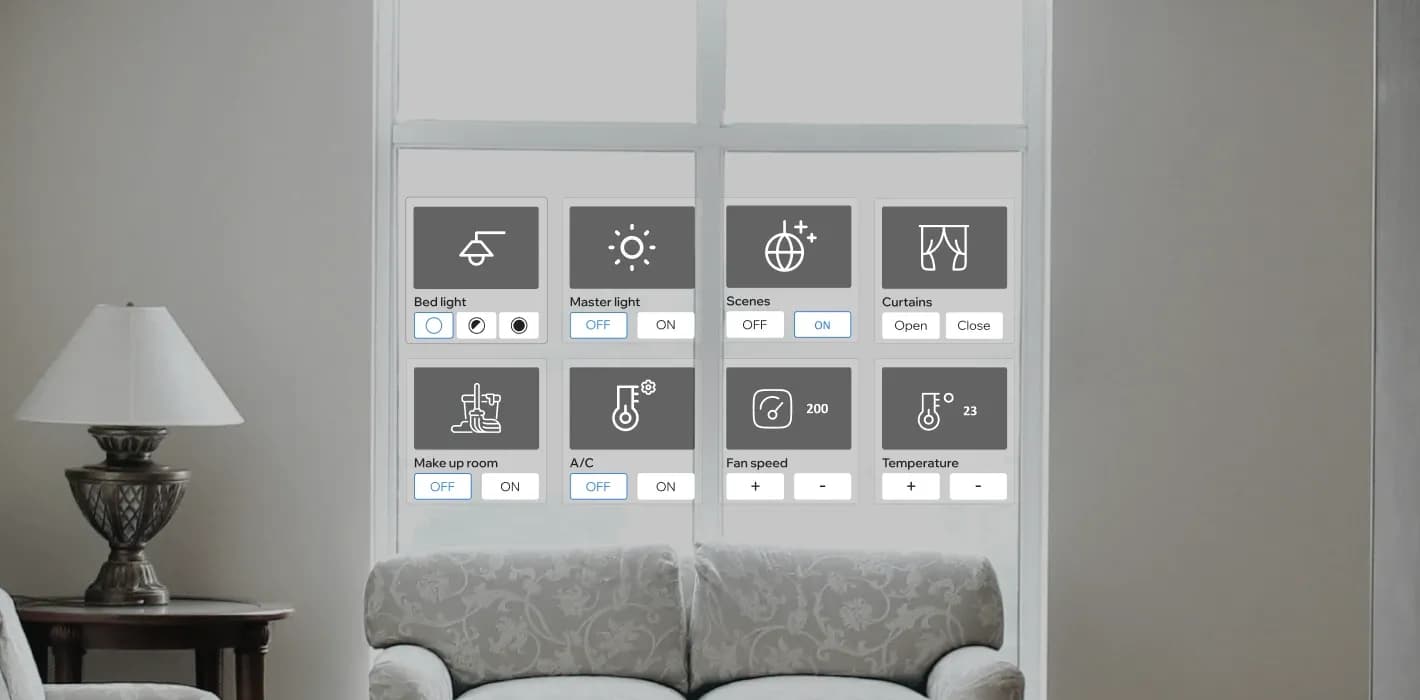
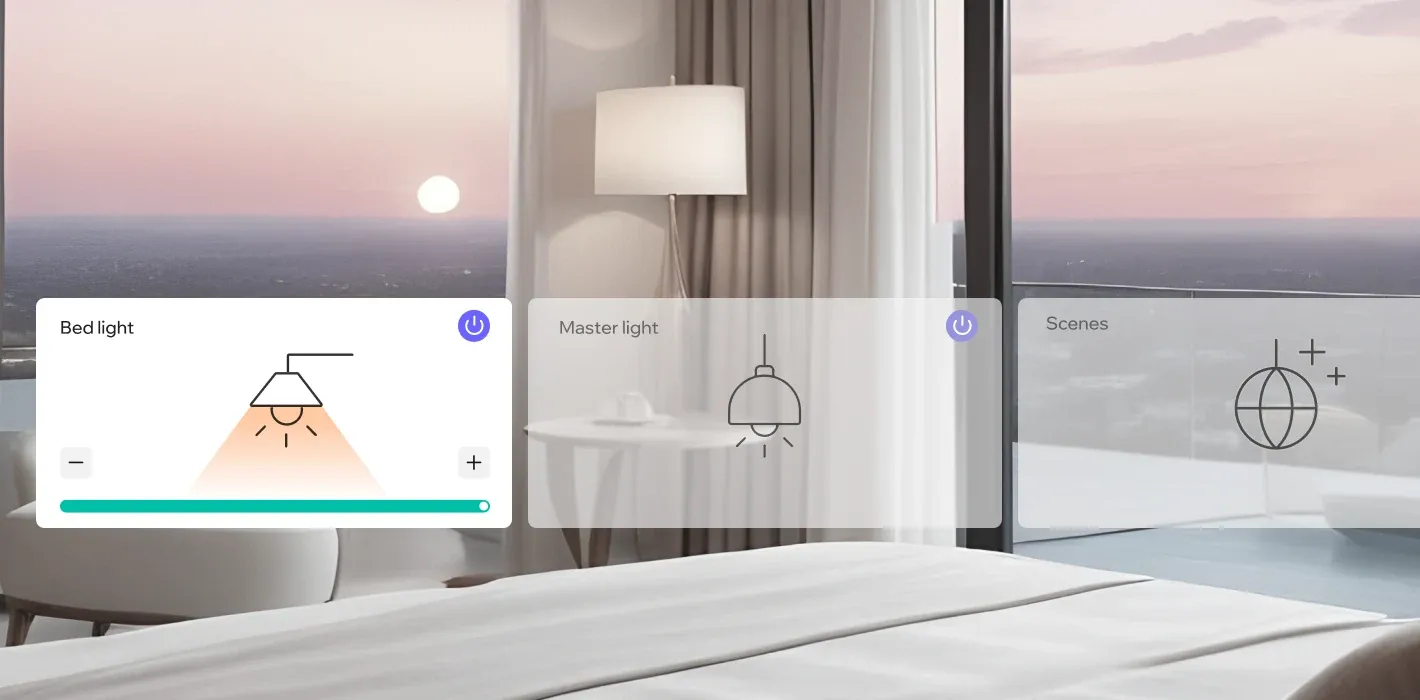
HotelSmarters offers room controls through both the interactive TV and the guest app, so lighting, temperature and entertainment sit behind an interface the guest is already looking at rather than a panel they must decode. For more detail, see our guide to the guest room management system.
Almost every hotel technology trends list stops at the guest room door. Your guests do not. Printed signage ages badly, and updating it costs somebody an afternoon. The trend here is screens that change themselves - a lobby board showing breakfast at eight and an event schedule by ten, with nobody reprinting anything.
HotelSmarters Digital Signage handles dynamic content scheduling by time of day, wayfinding and floor maps, an event and conference board, the daily restaurant menu, weather and local news widgets, and multilingual content for international groups. It supports QR codes that send guests straight to an offer, and an emergency broadcast override that takes every screen at once. Raise that last one with your operations team - it is rarely why a property buys signage and often why they are glad they did.
This is the least exciting trend here and the one most likely to sink the other nine. Casting needs bandwidth and a network that lets two devices find each other. Tablets need coverage, signage needs uptime, room controls need a connection that does not drop. When any of it fails, guests do not report a network problem. They report that your television is broken.
HotelSmarters Hotel WiFi gives you a guest self-service captive portal with a custom welcome message on login, control of your SSID and password, bandwidth throttling per room or guest tier so one heavy user cannot degrade a floor, guest device auto-reconnect, separate staff and guest network segmentation, and an admin-side usage analytics dashboard. Fund it before the visible things. A guest notices a fast, invisible network exactly once - when it is missing.
Most technology spending points at the guest. The pressure right now is on the people serving them. In the same AHLA survey, more than half of properties reported being somewhat or severely understaffed, and 42% named workforce shortages among their top cost challenges. Hotel automation aimed at your team answers that: housekeeping status that reaches the front desk the moment a room is ready, task routing that does not need a radio call, night audit steps that run unattended. Hotel housekeeping technology is unglamorous, and it removes real hours from real shifts.
One caution, because this is where projects overreach. Guest-facing platforms are not your automation layer. HotelSmarters products consume property management system data rather than replacing the systems that generate it, and if your PMS cannot share cleanly, nothing downstream works. Our guide to hotel PMS integration covers what to check before you sign.
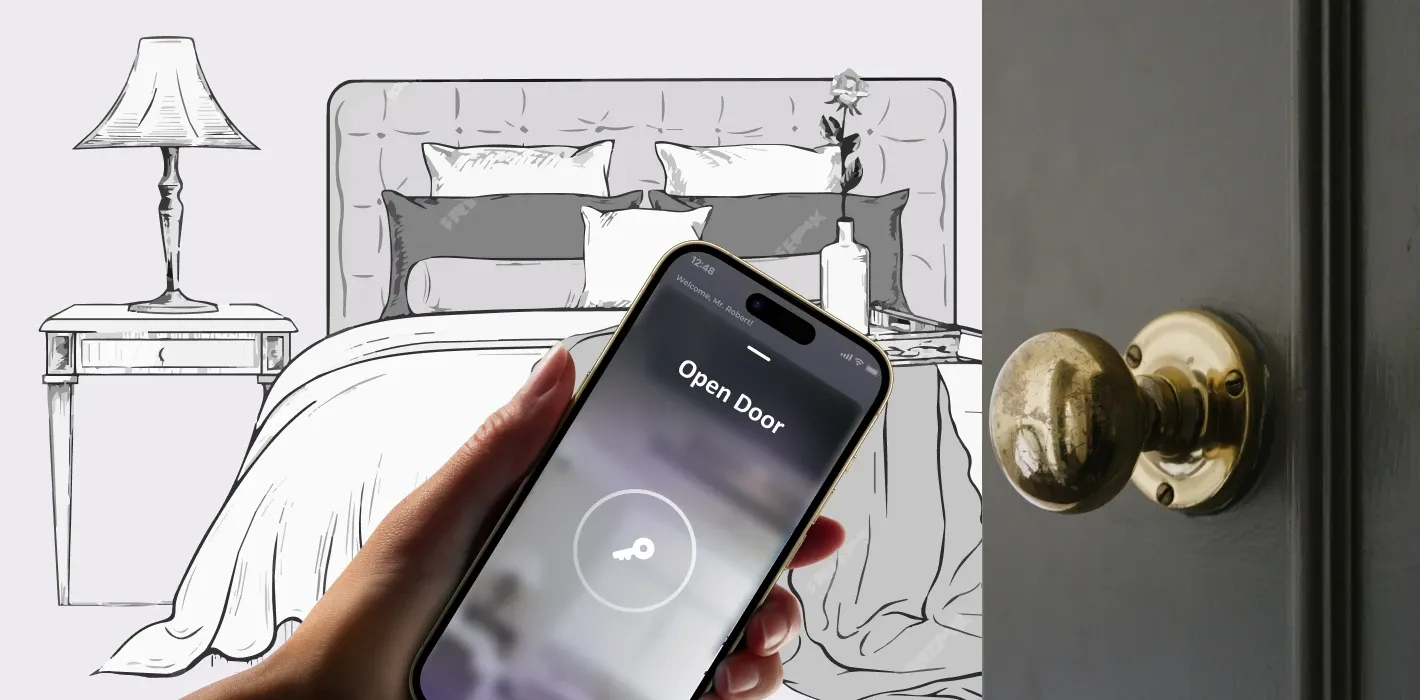
New technology in the hotel industry travels quickly from differentiator to expectation, and contactless is the clearest case. Hotel self-service technology - mobile check-in, a phone that opens the door, a lobby kiosk - was a real selling point five years ago. In 2026 it is what a business traveler assumes, and its absence is noticed far more than its presence. Treat contactless hotel technology as maintenance, not innovation: get it working, keep a staffed desk for guests who want one, and spend your differentiation budget elsewhere.
Every list you read this year assumes more technology produces a better stay. Spend a night in a badly equipped smart room and you learn otherwise.
The pattern is familiar. Three remotes with no indication which one works. A tablet dead since the last guest. A lighting panel with unlabeled icons, so the guest presses everything until something happens. None of this reads as advanced. It reads as a room that does not work, and it reaches your front desk as a call at eleven at night.
The numbers support it. The same 2026 outlook survey that found integration to be the industry's top concern also found properties on all-in-one platforms reporting check-in delays at 46%, against 23% on best-in-class systems. Guests never see which architecture you chose. They only feel the delay.
So use a simpler test than any vendor will offer. Can a tired guest, arriving at eleven at night in an unfamiliar room, use the thing without instructions? If the answer is no, it is a liability whatever it cost. This is why consolidation keeps recurring above: fewer surfaces, each already familiar, beats more capability spread across devices nobody was taught.
Not every trend earns its place at every property. Sequence them like this.
| Trend | Fund it first if... | Hold off if... |
|---|---|---|
| WiFi capacity and segmentation | Anything else here is planned, or reviews mention connectivity | Never. This one comes first. |
| Casting and in-room entertainment | Guests skew leisure, long-stay or international, and your TVs still show a fixed channel list | Your network cannot yet carry device-to-screen traffic |
| Interactive TV as a service hub | You want dining, spa or promotions in front of guests who never download an app | Your TVs are near end of life |
| Guest app | International guests, a small front desk, and messaging load you cannot absorb | Your guest mix is short-stay and unlikely to install anything |
| Digital signage | You run events or conferences, or your lobby confuses people | Your public spaces are small and static |
New technology in the hotel industry pays back fastest when it removes a repeated interruption for your team.
The technology is rarely the problem. This is.
| What goes wrong | Why it happens | What to do about it |
|---|---|---|
| Systems that will not talk to each other | Integration is the industry's most-cited concern, named by 38% of hotel professionals. Products get bought individually and integrated as an afterthought. | Get the integration path in writing before purchase. Confirm what data moves, in which direction, how often. |
| The replacement treadmill | With half of properties replacing or upgrading within two years, it is easy to buy into a cycle rather than a stack. | Buy for five years on infrastructure, shorter on guest-facing software. Do not replace both in one year. |
| Guest data you cannot account for | Every added system holds more guest information, and segmentation gets skipped in the rush to launch. | Keep staff and guest networks separate. Know which system holds what. Confirm accounts cannot cross rooms. |
| Nobody trained the front desk | Training is the first line cut when a rollout runs late. Your staff then become the reason guests think it does not work. | Budget training into the project, not after it. If your team cannot demo a feature in thirty seconds, guests will not either. |
Look back at the ten trends and a division appears. Some are back-of-house. Others are the layer your guest touches: the television, the app, the tablet, the lobby screen, and the network holding it together. That layer is what HotelSmarters builds. The interactive TV turns the screen already in the room into a service hub. The casting solution lets guests sign in to their own accounts without exposing them to the next room. The guest app and in-room tablets carry the same services onto a phone or a fixed device, with messaging and automatic translation for international guests. Digital signage keeps public spaces current without anyone reprinting a board. The WiFi platform supplies the captive portal, per-room bandwidth control and segmentation the rest depends on. All of it runs in multiple languages and carries your branding, not ours.
We do not replace your property management system. Our products consume its data, which keeps your stack intact and your integration surface small.
For a broader view of what belongs in the room, our guide to modern hotel in-room entertainment systems is a useful companion. To talk through which layer your property needs first, contact us.
The hotels that get 2026 right will not be the ones that bought the most. They will be the ones whose guests never had to think about any of it. Start with the network, then the screen already in the room, and let the rest follow the return.
If you are deciding what your guest-facing layer should look like this year, HotelSmarters builds exactly that. Get in touch with us and we will help you sequence it.

Co-founder / CTO
Armen is the CTO and Co-Founder of inoRain OTT and Co-Founder of HotelSmarters, specializing in advanced streaming technologies, OTT strategy, and interactive TV systems. He builds scalable end-to-end video delivery solutions and drives technical innovation across hospitality and streaming platforms, bridging complex engineering with practical business impact.