May 7, 2026
Now more than ever, maintaining a competitive edge requires optimizing every facet of hotel operations. One of the smartest ways to stay ahead? Implementing a hotel ERP system.
A hotel ERP system streamlines processes across departments, enhancing service quality and giving you a leg up in the market. In this article, you’ll learn how a hotel ERP system can transform your operations.
A hotel enterprise resource planning system is integrated software that manages every operational and financial layer of a hotel business - front office, back office, finance, HR, inventory, procurement, and guest data - on a single platform.
If a PMS is the front desk's brain, a hotel ERP is the entire property's nervous system. It connects what guest-facing teams do with what your finance and operations teams need to see, and rolls everything up across multiple properties when your business has grown beyond a single location.
Modern hospitality ERP software lives in the cloud, scales by property count rather than server count, and is increasingly built around APIs that connect to your existing PMS, channel manager, POS, and in-room technology stack.
Here are some essential features of hotel management ERP systems to help you choose the right solution.
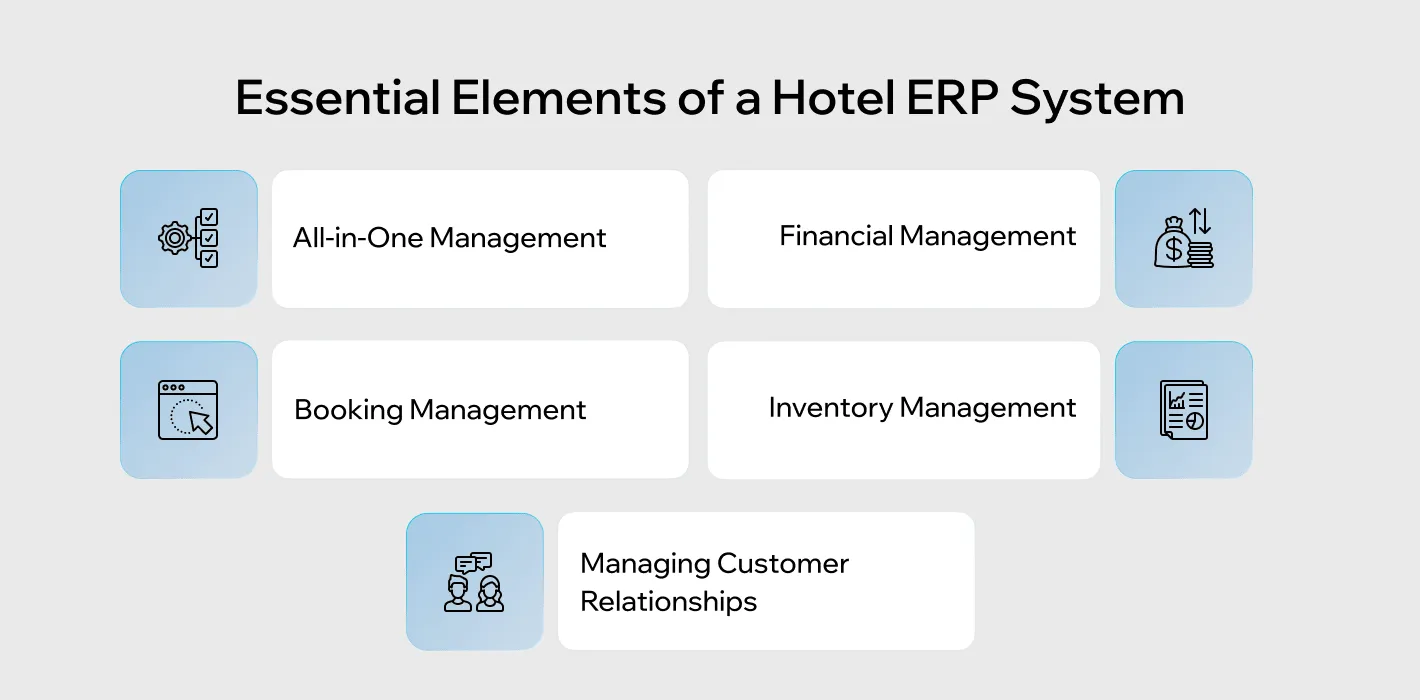
A hotel ERP enables you to unify various platforms, allowing seamless management across departments. By centralizing operations, you can reduce errors, streamline communication, and enhance efficiency in areas from housekeeping to guest services.
With hotel ERP software, managing bookings becomes simpler and more accurate. Real-time booking options provide up-to-the-minute room availability details, helping you prevent overbookings and boost your hotel’s credibility.
This level of accuracy improves guest satisfaction and strengthens your brand's reputation.
As an all-in-one tool, a hospitality ERP system helps you manage finances efficiently. From budgeting and forecasting to generating financial reports, the system provides comprehensive financial insights that support better decision-making.
This feature is particularly valuable for smaller hotels looking to optimize their cash flow and long-term profitability.
Many hotel ERP systems come with robust inventory management tools. You can monitor stock levels, manage resources like room supplies and maintenance equipment, and even automate key processes.
This ensures effective inventory control, reduces waste, and minimizes errors, ultimately saving time and cost.
A hotel ERP system also serves as a powerful tool for tracking guest profiles and preferences, allowing you to offer tailored experiences at every touchpoint—from the booking process to personalized meal options in your hotel dining areas.
This personalization can significantly impact guest satisfaction and loyalty. Studies indicate that 61% of guests are willing to pay more for a customized experience.
| Hotel ERP | PMS | All-in-One Hotel Management Software | |
|---|---|---|---|
| Primary purpose | Unify finance, operations, and back-office across properties | Run reservations, check-in/out, room status | Combine PMS + channel manager + booking engine in one product |
| Modules covered | Finance, HR, procurement, inventory, CRM, BI, operations | Reservations, housekeeping, guest folio, rate management | PMS modules + distribution + payments |
| Audience | Multi-property hotels, mid-market and enterprise chains | Any hotel of any size | Independent hotels and small chains |
| Typical price band | Mid-market to enterprise | SMB to enterprise | SMB |
| Typical buyer | Operations director, CFO, owner | GM, front office manager | Independent hotel owner |
If you only need front-desk efficiency, a PMS is enough. If you have multiple properties or your finance team is buried under manual reconciliation, you've outgrown a standalone PMS and you're in ERP territory. For more on connecting these systems, see our guide to hotel PMS integration.
This is the section most articles skip. The honest answer: hotel ERP cost lives in three layers, and the layer most properties under-budget for is the second one.
| Cost layer | What it covers | Typical range |
|---|---|---|
| Software subscription | Per-property or per-user licensing, module bundles, support tier | SMB cloud ERP: $50–$300/mo per property. Mid-market: $300–$1,500/mo. Enterprise: custom quote |
| Implementation and data migration | Discovery, configuration, data cleanup, migration from legacy systems, integration with PMS/POS/payments | One-time. Often equal to or larger than year-one subscription. Mid-market budgets typically start in the low five figures |
| Ongoing maintenance and integration | Premium support, additional integrations, training new staff, version upgrades | Annual recurring; often 15–25% of year-one cost |
A hotel ERP changes how the business runs in concrete ways:
Automating routine work — invoice matching, stock reordering, payroll runs, month-end close — frees your staff for guest-facing work, which is where service quality is actually built.
The average mid-size hotel runs between 8 and 15 separate software products, and very little of that data flows automatically into the financial system. An ERP unifies the data spine and turns days of manual reconciliation into a closed-loop process.
A hospitality ERP lets you capture guest preferences, stay history, and spend across every property in one record. That data can power personalized stays — from preferred room temperature to dining recommendations. One study cited by EHL Hospitality Insights found that 61% of guests are willing to pay more for a customized experience.
If you operate more than one property, consolidation is a constant headache. An ERP rolls up financial statements automatically, so finance leadership spends less time gathering numbers and more time interpreting them.
Real-time data — occupancy trends, supplier price drift, payroll variance — surfaces operational issues before they show up in a P&L. The result is fewer surprises and more confident pricing, staffing, and capital decisions.
Cloud-based hospitality ERP software lets you add properties, modules, or users without major infrastructure investment. That's how independent groups go from two hotels to twenty without the back office breaking.
To make your search easier, here is a table showing the five best hotel ERP systems:
| ERP System | Price Range | Key Benefits | Best For | Free Trial |
|---|---|---|---|---|
| Oracle OPERA Cloud | $500 - $1,500 per month | Comprehensive features for large-scale hotels | Major hotel chains | Yes |
| SAP Business One | $1,000 - $2,000 per month | Amazing financial management capabilities | Small to medium-sized hotels | Yes |
| Maestro PMS | $300 - $1,200 per month | Integrated front- and back-office solutions | Resorts & hotels | Yes |
| RoomRaccoon | $150 - $400 per month | Focuses on automation for small hotels | Boutique hotels | Yes |
| eZee Absolute | $50 - $200 per month | Cloud-based solution ideal for small hotels | Small & mid-sized hotels | Yes |
| Cloudbeds | $20 - $100 per month | All-in-one hospitality management platform | Various hotel types | Yes |
There are dozens of capable systems in the market, and the wrong one is usually a system that's bigger or smaller than the property actually needs. Run any shortlisted vendor through these seven questions before signing:
Buying an ERP because it has the most features is the most common mistake hoteliers make. Match modules to operations, not feature counts.
Hotel ERP Implementation: Timeline, Risks, and How to Get It Right Most ERP failures aren't software failures. They're project failures. A typical hotel ERP rollout moves through four phases:
The three highest-risk parts of the rollout — the ones to budget extra time and money for:
Properties that succeed treat the rollout as a six-month operational project with software at the center — not as a software install with a training session at the end.
A hotel ERP system isn't a feature upgrade. It's the operational backbone your business runs on as soon as your stack outgrows the front desk. The properties getting the most out of theirs are the ones that pair the right ERP with the right integration layer - connecting back-office systems to the in-room experience your guests actually feel.
A hotel ERP system allows you to personalize guest services by tracking individual preferences and building detailed guest profiles. With this data, you can respond promptly to requests and deliver tailored experiences that make each stay memorable.
Hotel ERP systems streamline routine tasks through automation, which reduces reliance on manual labor and minimizes human errors. This efficiency ultimately lowers operating costs and improves overall productivity.
Yes, absolutely! Many modern hotel ERP systems are scalable, meaning they can be tailored to fit hotels of any size, including small boutique properties. This flexibility makes ERP solutions accessible and effective for boutique hotels looking to enhance their operations.

Product Manager
Leads smart hotel tech products. Focused on interactive TV and PMS integrations. Turns guest needs into simple, effective solutions. Loves building products that improve hotel operations and enhance guest experience.