July 3, 2026
Every drink poured at your lobby bar, every room-service order, every poolside lunch runs through one piece of technology: your point-of-sale system. Pick the wrong one and you get slow service, charges that never make it to the right room, and an F&B operation that leaks revenue instead of growing it. Pick the right one and the best hotel POS system becomes the quiet engine behind a profitable food and beverage program.
The trouble is that most "best POS" lists are built for standalone restaurants, not hotels. This guide compares seven hotel POS systems that actually fit how a property runs, with honest pros, cons, pricing, and a clear "best for" so you can shortlist faster.
Food and beverage is where hotels are finding growth right now. In the first half of 2025, hotel F&B revenue per occupied room rose 3.8%, outpacing the 3.0% growth in total hotel revenue, according to CBRE Hotels Research. F&B is the second-largest revenue source in the industry, and department profit margins climbed to 29.1% over that same period.
The scale is meaningful. F&B typically drives 25-30% of total revenue at full-service hotels, and 35-45% at luxury and resort properties. That revenue flows through your POS. A system that posts charges cleanly to the guest folio, keeps working when the internet drops, and gives you menu-level data is no longer a back-office nicety. It is the difference between an F&B operation that defends its margin and one that quietly gives it away.
A hotel POS is not the same as a restaurant POS. The bar for this list was hospitality fit, not just feature count. We weighed each system on:
Each pick below states exactly which kind of property it suits best, because the right answer for a 400-room resort is rarely the right answer for a 30-room boutique.
| System | Best for | Starting price | Standout strength |
|---|---|---|---|
| Oracle MICROS Simphony | Large, luxury, and resort hotels | From ~$55/month (enterprise pricing) | Deep integration with Oracle OPERA PMS |
| Agilysys InfoGenesis | Resorts, casinos, multi-outlet operations | Custom quote | Hospitality-focused with robust offline mode |
| Lightspeed Restaurant | Boutique and food-focused hotels | From ~$69/month | Advanced inventory and menu management |
| Toast | Hotel restaurants and bars | From $0–69/month | Comprehensive restaurant features and online ordering |
| Square | Small and independent hotels | $0 or from ~$69/location/month | Easy setup with minimal upfront commitment |
| Shift4 / SkyTab | Bundled hardware and payments | From ~$29.99/terminal/month | Low upfront cost with an all-in-one solution |
| Clover | Flexible hardware, single outlets | From ~$60–179/month | Modular hardware and extensive app marketplace |
Prices are starting points from 2025-2026 vendor and review sources. Almost every hotel deployment is ultimately quoted, so treat these as a guide and confirm a property-specific number with each vendor.
Oracle MICROS Simphony is the enterprise standard for hotel food and beverage, and for good reason. It integrates natively with Oracle OPERA, the most widely used hotel PMS, so room charges, folios, and revenue postings flow without manual workarounds. For a multi-outlet property juggling a restaurant, bar, room service, and banquets, that single-stack reliability is hard to match.
Best for: Large, full-service, luxury and resort hotels, especially those already on Oracle OPERA.
Key features: Native OPERA PMS integration, multi-outlet and enterprise management, offline resilience, kitchen display, advanced XBR reporting, global support.
Pricing: Cloud subscriptions start around $55/month (Essentials) and $75/month (Plus). Per-terminal enterprise pricing commonly runs $75-$200 per terminal per month, with large deployments custom-quoted. Workstation hardware starts near $1,000.
Pros: The deepest hotel and PMS integration on this list; proven at enterprise scale; highly configurable for complex resort operations.
Cons: Higher cost and complexity; overkill for small properties; usually needs a partner to configure and deploy.
Agilysys InfoGenesis was built for hospitality from the ground up, not adapted from retail. It handles food and beverage, retail, minibar, and activity-center transactions across fixed terminals, kiosks, and the IG Flex mobile handheld. Its offline mode is a genuine strength for sprawling resort properties where connectivity can be patchy. In December 2025, the platform was approved across the IHG Hotels & Resorts portfolio, a strong signal of enterprise trust.
Best for: Full-service hotels, resorts, casinos, and multi-outlet properties.
Key features: Hospitality-specific design, IG Flex mobile and tableside POS, robust offline capability, multi-language and multi-currency, room-charge posting.
Pricing: Custom quote only; enterprise and contract based.
Pros: Purpose-built for hospitality; excellent offline reliability; trusted by major hotel groups.
Cons: No public pricing; longer sales and implementation cycle; not aimed at small independents.
Lightspeed Restaurant is a polished cloud POS that shines in boutique and mid-size hotels with a serious restaurant, bar, or cafe. Its inventory and menu management tools are a step above the basics, which matters if your F&B program is a destination in its own right rather than an amenity.
Best for: Boutique and mid-size hotels with a food-forward F&B outlet.
Key features: Cloud POS, advanced inventory and menu management, tableside ordering, strong analytics, multi-location support, an integrations marketplace.
Pricing: Basic starts around $69/month, Essential around $189/month, and Premium around $399/month, with annual billing lowering the rate. In-person processing runs about 2.6% plus $0.10; extra registers are around $59/month.
Pros: Strong inventory and reporting; clean, modern interface; great fit for food-led boutique properties.
Cons: Costs climb as you add modules; a surcharge applies if you bring your own payment processor; not a hotel-native, PMS-first system.
Toast is a restaurant-first cloud POS with excellent handheld hardware and a best-in-class online ordering and delivery experience. If your hotel restaurant operates almost like an independent venue, courting outside diners as well as guests, Toast gives your F&B team the tools they would expect from a standalone restaurant.
Best for: Hotel restaurants, bars, and F&B-led properties that also serve non-guests.
Key features: Android-based handhelds, online ordering and delivery, kitchen display, loyalty and marketing, payroll, restaurant-grade reporting.
Pricing: A pay-as-you-go Starter Kit is $0/month with higher processing; the core Point of Sale plan is around $69/month, and Essentials starts near $165/month. Processing runs roughly 2.49%-3.69%, hardware $799-$1,500 and up, usually on a two-year contract.
Pros: Outstanding restaurant and F&B feature depth; strong handheld and online-ordering experience; widely supported.
Cons: Built for standalone restaurants, so native PMS room-charge integration is limited; long contracts; add-ons and processing inflate the real monthly cost.
Square is the easiest and cheapest way to get a credible POS running in a small or independent property. For a B&B, a budget hotel with a grab-and-go counter, or a single lobby cafe, the free tier and no-contract pricing remove almost every barrier to getting started.
Best for: Small and independent hotels, B&Bs, and low-volume single outlets.
Key features: Free entry tier, fast setup, integrated payments, mobile and handheld hardware, online ordering, basic loyalty and reporting, a large app marketplace.
Pricing: A free plan at $0 per location; Square for Restaurants Plus from around $69 per location per month; Premium from around $165. In-person processing starts at 2.6% plus $0.15, with no long-term contract.
Pros: The easiest and lowest-cost way to start; no contract; transparent flat-rate pricing; ideal for low-volume outlets.
Cons: Limited for complex multi-outlet operations; no native hotel room-charge posting; flat processing becomes expensive at high volume.
Shift4's SkyTab (now Shift4 Dine) leads with an aggressive bundle: hardware, software, installation, and support for a low monthly fee, with the real cost recovered through integrated payment processing. For a hotel that wants to minimize upfront spend and keep payments and POS under one roof, it is a practical option.
Best for: Hotels that want bundled hardware and integrated payments with low upfront cost.
Key features: Low-cost bundled hardware (touchscreen, cash drawer, printer), 24/7 support, online ordering, tableside service, several PMS integrations, end-to-end payments.
Pricing: From around $29.99/month per terminal with $0 upfront for hardware and software, bundled with Shift4 payment processing (negotiated rates roughly 2.3%-2.75%).
Pros: Very low upfront cost; hardware, software, and payments in one bundle; PMS integrations for hotel restaurants.
Cons: The "free" hardware is tied to a long-term processing agreement; pricing is quote- and processing-dependent; less enterprise depth than Oracle or Agilysys.
Clover is known for attractive, modular hardware and a deep app marketplace. For a small or mid-size hotel running a single restaurant or bar, its mix of countertop, compact, and handheld devices makes it easy to tailor a setup to your space.
Best for: Small to mid-size hotels with a single F&B outlet that value flexible hardware.
Key features: Modular hardware (Station, Mini, Flex handheld), broad app marketplace, inventory, loyalty, online ordering, integrated payments.
Pricing: Counter Service plans from around $60/month and full-service from around $90-$179/month, depending on term and hardware. Processing runs roughly 2.3%-2.6% plus $0.10.
Pros: Flexible, well-designed hardware; a large app ecosystem; sensible plans for a single outlet.
Cons: Pricing and processing vary by reseller; not hotel-native, with no built-in room-charge posting; hardware can be locked to a specific processor.
The vendor matters less than the fit. As you shortlist, weigh these factors against how your property actually operates.
A POS closes the transaction, but it does not create the demand. That part of the job belongs to your guest-facing technology, and the two work best in tandem. A guest who can browse the room-service menu, see a spa promotion, or order a poolside drink from their own device or screen is a guest who spends more, and every one of those orders still lands in your POS.
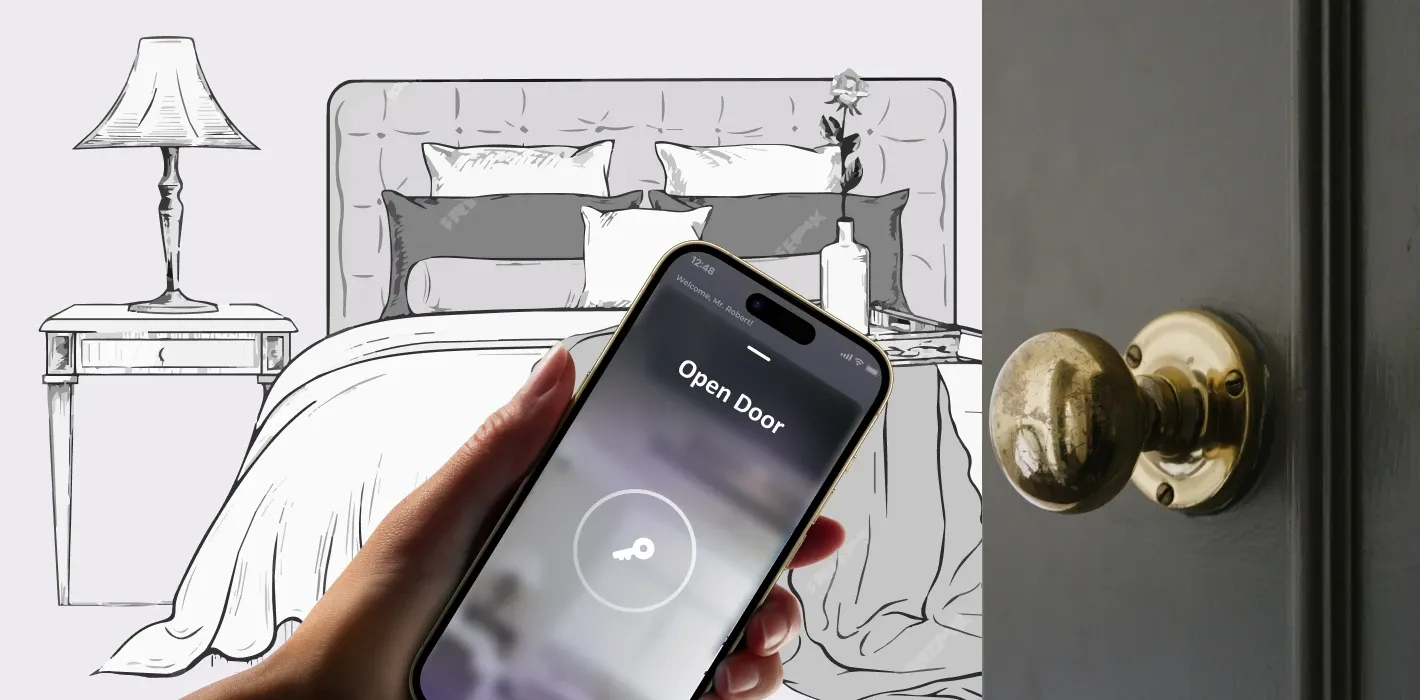
That is where HotelSmarters fits. Our Guest App lets guests order food, request service, and explore your offerings from their phone, while Hotel In-Room Tablets put your in-room dining and amenities a tap away at the bedside. Hotel Interactive TV turns the guest-room screen into a promotional channel for your restaurant, bar, and services. None of these replace your POS. They feed it, by turning passive guests into active spenders.
Choose the POS that fits your operation, then make sure the guest experience around it is working just as hard. Get in touch with us to talk through the guest-facing side.
The best hotel POS system is the one that matches your property, not the one with the longest feature list. Map your size, your F&B ambitions, and your PMS before you shortlist, and the right fit becomes clear. Once your POS decision is sorted, the next question is what runs on top of it to drive guest spend. To talk through the guest-experience technology that complements your POS, get in touch with us or explore more at HotelSmarters.

Product Manager
Leads smart hotel tech products. Focused on interactive TV and PMS integrations. Turns guest needs into simple, effective solutions. Loves building products that improve hotel operations and enhance guest experience.