July 10, 2025
Your guests have planned the trip, packed the bags, and landed - the last thing they want is a 10-minute wait at your front desk. For hotels still relying on manual check-in, that queue is not just a frustration. It is a first impression that colors the rest of the stay.
Hotel mobile check-in changes that equation. By letting guests complete the arrival process on their smartphones before they walk through your door, you eliminate the queue, free up your team, and create upsell opportunities that traditional check-in never offered. This guide covers everything you need to know: how the technology works, the business case, PMS integration requirements, and a practical implementation plan.
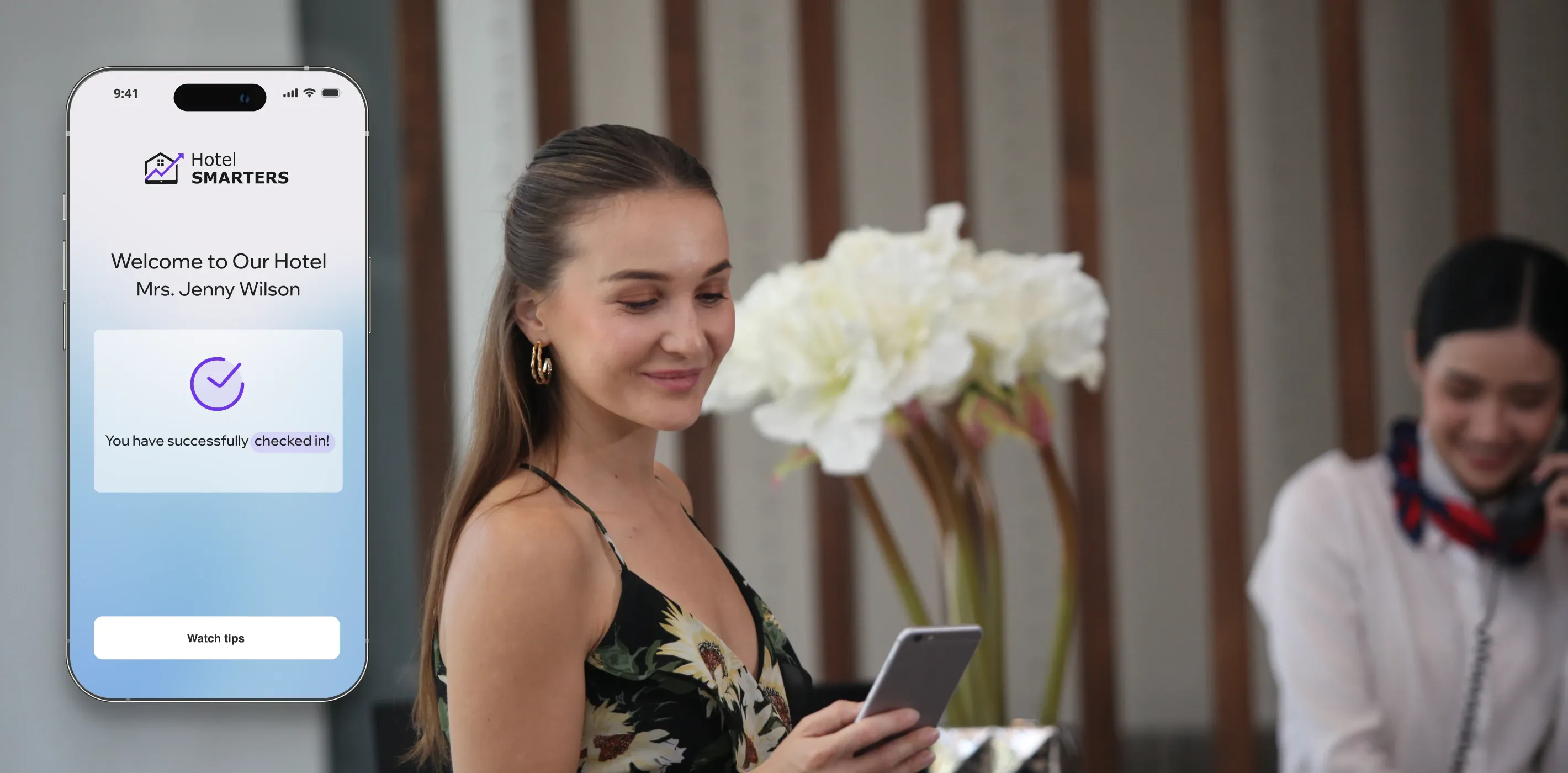
Hotel mobile check-in is a self-service technology that allows guests to complete the arrival process remotely, using their smartphone or personal device, before or upon reaching the property.
It sits alongside the booking process but is a separate step. Once a guest has a confirmed reservation, they receive access to the check-in flow through one of two delivery methods:
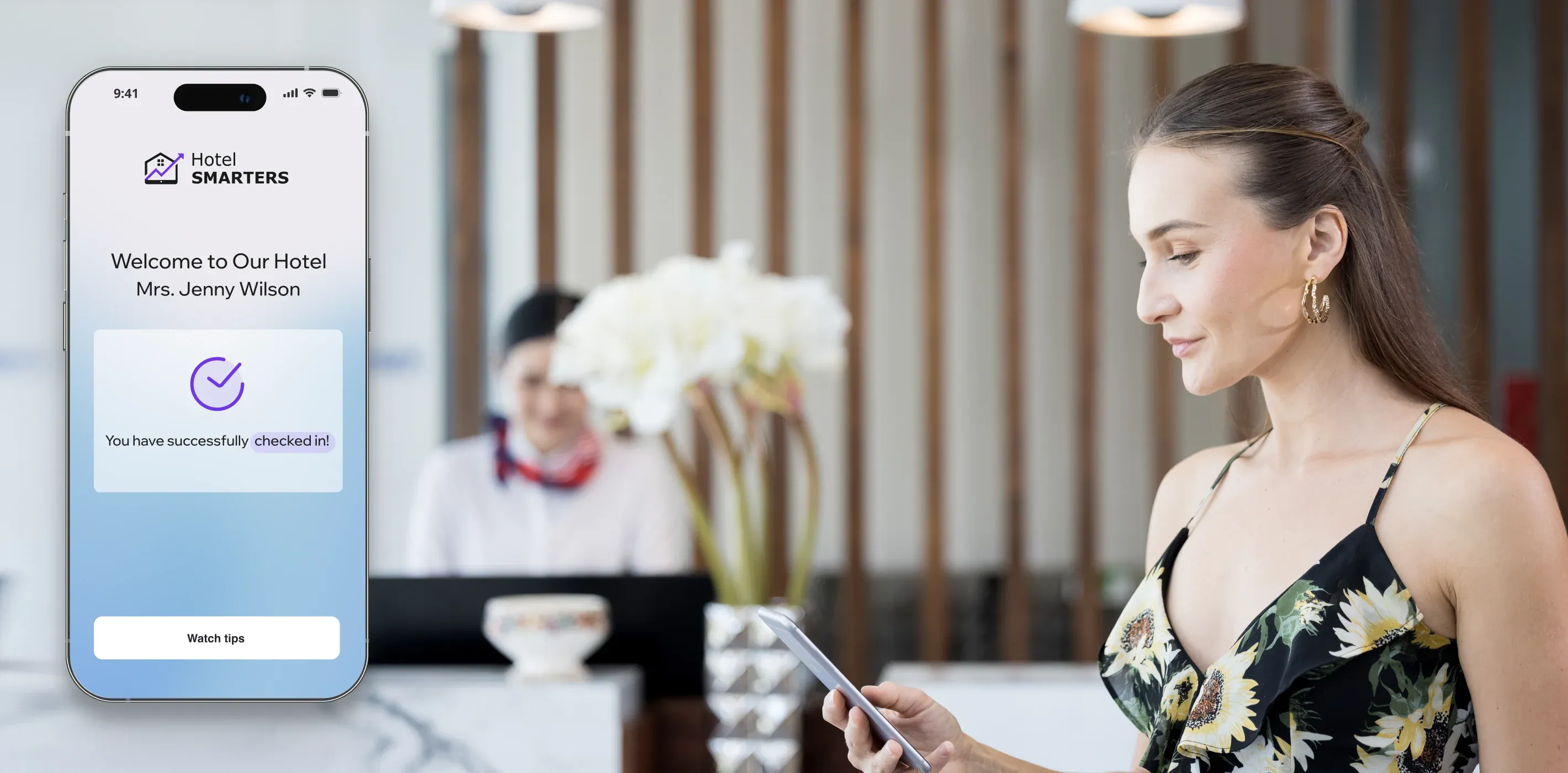
Either method lets guests skip the front desk entirely. Many platforms also offer room upgrade options, amenity add-ons, and personalization choices as part of the flow - turning a logistical step into a revenue touchpoint. This means that even the question of what is mobile check in hotel carries a clear operational answer: it is a technology that replaces the desk queue with a faster, more flexible arrival experience for every guest type.
The process looks simple from the guest side. Behind the scenes, several systems are working in parallel. Here is how it plays out from the moment a guest receives their pre-arrival message to the moment they leave.
From the guest's side:
From the hotel's side:
No manual re-entry. No paper forms. No front desk bottleneck during peak arrival hours.
Here is how the two methods compare across the metrics that matter most to hotel operations.
| Feature | Mobile Check-In | Traditional Check-In |
|---|---|---|
| Check-in process | Completed remotely via smartphone before arrival | Guests arrive and check in at the front desk |
| Time management | Guests skip queues and go directly to their room | Can slow significantly during peak arrival times |
| Room selection | Guests choose room type or preferences before arrival | Room assigned by staff during check-in |
| Key management | Digital key delivered directly to the guest’s smartphone | Physical key card issued at the front desk |
| Real-time updates | Room status, upgrades, and offers sent to the guest’s device | Updates shared in person or through printed materials |
| Upsell opportunities | Add-ons offered during digital check-in at peak engagement | Limited to short in-person suggestions |
| Guest experience | Convenient, personalized, and frictionless from the start | Can feel slower and less personalized during busy periods |
Travelers increasingly expect digital experiences that match what they get from airlines, rideshares, and e-commerce. Mobile check-in meets that expectation at the very first moment of contact with your property.
Time savings. Guests skip the queue and go straight to their room. For business travelers arriving late or families with young children, that is not a minor convenience - it is the difference between a good first impression and a frustrated one.
Flexibility and convenience. Check-in happens on their schedule. Guests submit information from the airport, a taxi, or wherever they are. If they need to adjust hotel amenities selections or make special requests, it all happens on the same platform.
Personalized arrival before they even walk in. Mobile check-in is often the first moment guests actively shape their stay. Room type selection, upgrade offers, and special requests happen here - before arrival. That sense of control builds satisfaction before they set foot in the lobby.
Service continuity throughout the stay. Mobile access does not end at check-in. When paired with in-stay tools, guests can reach the front desk, request services, and manage bookings without a phone call or a trip to reception.
Industry research shows that around 70% of guests now prefer using their smartphones for check-in and in-stay services - a figure that has risen consistently as traveler expectations shifted toward self-service.
Mobile check-in is not just a guest convenience feature. For hotel operators, it is a tool that touches revenue, staffing efficiency, and long-term loyalty in parallel. Here are the three pillars of the business case.
1. Operational efficiency
Manual check-in is time-intensive. Industry benchmarks put the traditional process at five minutes or more per guest at the desk. Mobile check-in compresses that to around one minute for staff verification and completion. During peak check-in windows - typically 3:00 to 6:00 PM - that efficiency gain is the difference between a smoothly running front desk and a lobby full of impatient guests. With fewer guests requiring desk attention, your team redirects time to higher-value interactions: VIP greetings, special requests, and problem-solving that actually requires a human.
2. Revenue from upselling at the right moment
Traditional check-in leaves upselling to chance - a brief conversation with a distracted guest in a busy lobby. Mobile check-in places upgrade offers, dining packages, spa bookings, and late checkout options in front of guests when they are most engaged with their arrival. Properties that use their check-in flow as an active upsell channel consistently report meaningful incremental revenue per stay compared to desk-only operations.
3. Cost reduction
Fewer manual processes mean fewer labor hours on repetitive administrative tasks and less printed paperwork. For high-volume properties, those savings compound. Many operators reinvest the difference in guest experience improvements - better amenities, staff training, or a more capable mobile platform - creating a cycle that reinforces itself.
The global contactless hotel technology market reached $4.8 billion in 2025 and is projected to reach $14.6 billion by 2034. That trajectory reflects where hotel operations are heading industry-wide. Most properties see positive ROI from mobile check-in within 12 to 18 months, driven by the combination of operational savings and upsell revenue.
Mobile check-in is only as effective as the systems it connects to. A guest-facing app that does not sync with your Property Management System (PMS) creates more work, not less - your staff will re-enter data the guest already submitted, and the efficiency gains disappear immediately.
The benchmark for effective PMS integration is two-way, real-time data sync. When a guest checks in on their phone, the following should happen automatically in your PMS:
Three questions to ask any hotel mobile check-in solutions provider before committing:
A provider that clears all three is worth the investment. One that stumbles on any of them will generate more admin work than it eliminates.
These steps apply whether you are deploying mobile check-in for the first time or replacing a legacy solution.
Audit your existing tech stack. Identify your current PMS, lock management system, and any reservation or loyalty tools in use. Your mobile check-in solution must connect cleanly to all of them - gaps will surface as manual workarounds later.
Choose a reliable provider with strong integration support. Look for a platform with a documented integration history for your PMS and a support team that stays involved through go-live. A smooth setup matters far more than a long feature list.
Ensure seamless, bidirectional data sync. During implementation, test the data flow in both directions before going live. Confirm that guest submissions update your PMS automatically and that PMS changes surface correctly in the guest-facing interface.
Train your front desk team. Even with full mobile check-in adoption, staff will handle exceptions: guests who need assistance, digital key issues, or walk-ins without a reservation. Make sure everyone understands the system and the fallback process.
Promote the feature to incoming guests. Use pre-arrival emails, booking confirmation messages, and on-property signage to let guests know mobile check-in is available. Clear, simple instructions drive adoption - link directly to the check-in flow, not just the homepage.
Evaluate the provider's PMS compatibility and long-term support commitment. Before finalizing any agreement, confirm which PMS versions are supported, what the integration testing process looks like, and what escalation looks like after go-live. This step is the most frequently skipped - and the most consequential when something goes wrong at 2:00 AM on a Friday.
Mobile check-in gets your guests to their rooms. What happens from that moment forward determines whether they come back.
HotelSmarters' Guest App - Smarters MOBILE - is built for the in-stay side of that equation. Once guests have checked in, the app puts your entire hotel at their fingertips: in-room dining orders, room controls, transfer bookings, spa reservations, and real-time messaging with your front desk - all from their own phone, with no queue and no calls required.
Every feature runs through a fully branded app that carries your hotel's identity, not a generic third-party interface. Your team gets a clean channel to upsell dining, spa packages, and experiences at the moments when guests are most receptive. The result is a guest experience that feels seamless from arrival to checkout - and operational workflows that are faster and less dependent on foot traffic to the desk.
To explore how Smarters MOBILE fits into your mobile strategy, contact us for a closer look.
Hotel mobile check-in is one of the clearest examples of a hospitality technology investment where guest satisfaction and hotel business performance improve together. Guests get a faster, more personalized arrival. You get a more efficient front desk, a natural upsell touchpoint, and the data to build lasting guest relationships.
The question for most operators is not whether to adopt it - it is how to implement it in a way that integrates cleanly with existing systems and drives genuine adoption. To explore what that looks like for your property, get in touch with us.
What is mobile check-in for hotels?
Hotel mobile check-in is a self-service process that allows guests to complete the arrival formalities on their smartphone before or upon reaching the property. Through a hotel app or a link sent via SMS or email, guests confirm their details, select a room, and receive a digital confirmation - all without visiting the front desk.
Can guests check into a hotel using their phone?
Yes. Most modern mobile check-in systems work directly on the guest's smartphone through a dedicated hotel app or a mobile-optimized web link. After submitting the required information and receiving confirmation, guests can access their room using their phone via a compatible smart lock system if the property supports digital keys.
What are the benefits of a mobile check-in app for hotels?
Mobile check-in reduces front desk congestion, frees staff for higher-value guest interactions, creates natural upsell opportunities during the check-in flow, and consistently improves guest satisfaction scores. For hotel owners, the business case also includes operational cost savings and faster ROI compared to most other front-desk technology investments.
Can you check into a hotel remotely?
Yes. With a mobile check-in system, guests complete the entire process from anywhere with an internet connection: submitting their details, selecting room preferences, and receiving a digital key before arriving at the property. Remote check-in is typically available 24 to 48 hours before the scheduled arrival, depending on the platform.
How does hotel mobile check-in integrate with a PMS?
Integration works through a two-way data sync. When a guest checks in via the mobile system, the information flows automatically into the hotel's PMS - updating room status, logging the guest profile, and posting folio charges without manual input. A strong integration also triggers downstream actions like housekeeping notifications and digital key activation. Always confirm bidirectional, real-time sync with any provider before deployment.
Which hotels offer mobile check-in?
Mobile check-in is now available at the majority of branded hotel chains globally, including major hospitality groups and their loyalty app ecosystems. Independent hotels and mid-size properties increasingly offer it through third-party platforms that connect with their existing PMS. If your property is not yet offering it, you are already behind the baseline expectation among frequent travelers - most guests who have experienced it elsewhere will notice its absence.

Product Manager
Leads smart hotel tech products. Focused on interactive TV and PMS integrations. Turns guest needs into simple, effective solutions. Loves building products that improve hotel operations and enhance guest experience.