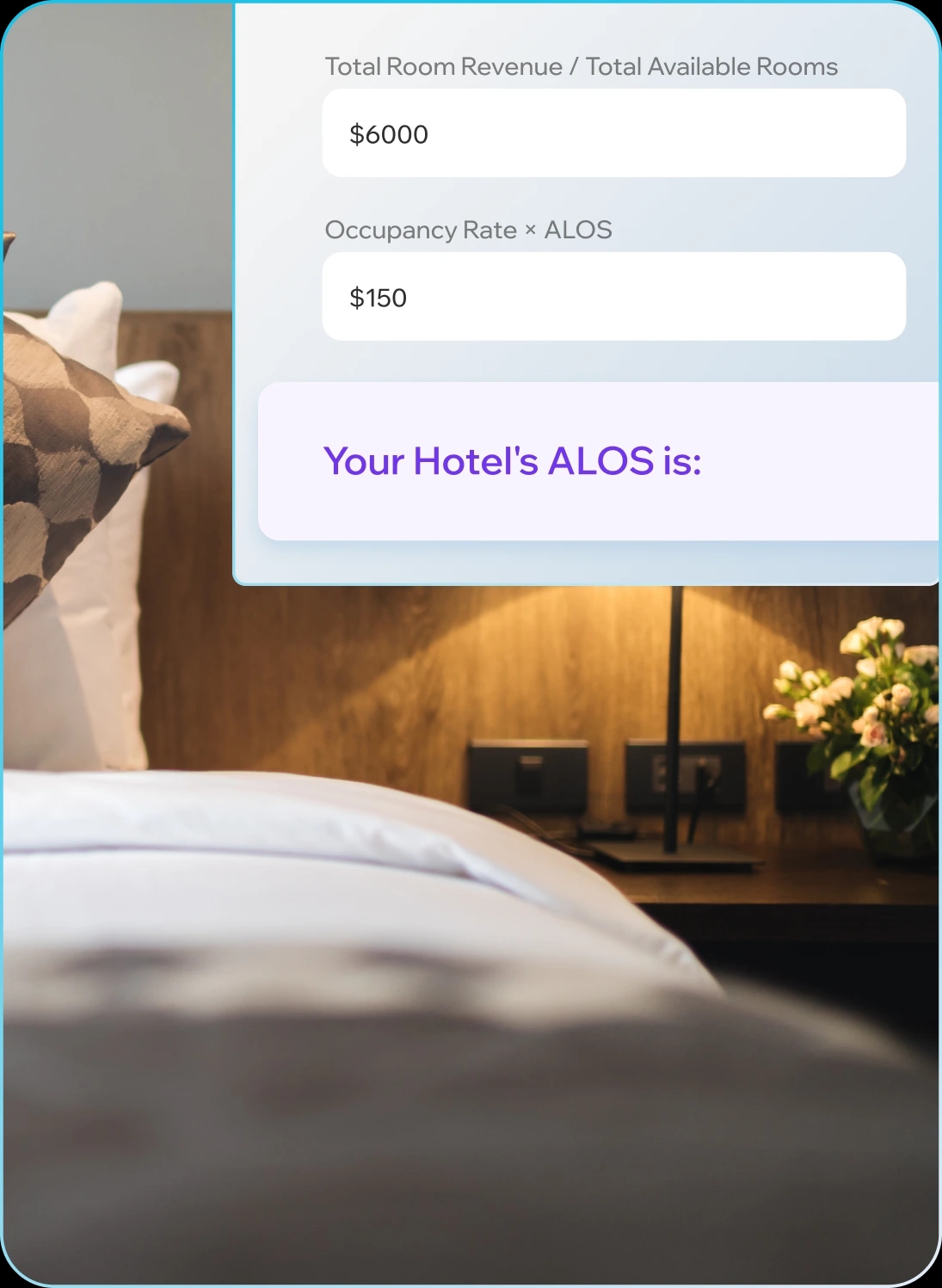
Average Length of Stay ALOS Calculator

Calculate your hotel's average length of stay instantly. Understand what your number means - and use it to reduce operational pressure, increase revenue per booking, and attract higher-value guests.

Calculate your Hotel’s ALOS

What is Average Length of Stay and Why Does It Matter?

The Average Length of Stay (ALOS) is one of the most practical metrics in hotel performance management. It tells you how long guests typically stay at your property during a given period - and what that pattern means for your revenue, operations, and guest mix.

The ALOS formula is straightforward:

Average Length of Stay = Total Number of Room Nights / Total Number of Bookings

Unlike occupancy or ADR alone, ALOS gives you a window into the quality and structure of your bookings - not just whether rooms are filled.

Across the industry, ALOS can vary widely:

  • Business hotels1–3 nights, driven by short corporate trips
  • Boutique hotels and B&Bs2–4 nights, influenced by guest preferences and season
  • Resorts and vacation rentals5–7 nights, as leisure guests stay considerably longer

Knowing where your property stands lets you set realistic targets, identify gaps, and make smarter decisions across pricing, marketing, and operations.

Why ALOS Matters for Hoteliers

Longer stays generate higher booking value per guest with lower cost per check-in and check-out

ALOS reveals whether your current guest mix aligns with your revenue goals

Changes in ALOS signal shifts in demand, guest behavior, or pricing effectiveness

Tracking ALOS over time helps you plan staffing, housekeeping, and inventory more accurately

How the ALOS Calculator Works

The HotelSmarters ALOS Calculator is designed for speed, clarity, and immediate action. Enter your total room nights and total bookings for any period - daily, weekly, monthly, or seasonal - and get your average length of stay in seconds.

No spreadsheets. No formulas to remember. Just a clear number that tells you what each sold room is actually costing your business.

No spreadsheets. No manual formulas. Just a clean, reliable number you can act on.

  • Forecast demand and adjust pricing dynamically
  • Segment guests by revenue contribution, not just volume
  • Align marketing spend with high-ADR or high-conversion periods
  • Optimize room inventory during high and low seasons
  • Benchmark against competitive sets or market averages

Once you have your number, the real work begins: understanding what it means for your specific property.

What a Low ALOS Really Means

When your ALOS is lower than it should be, the number itself is not the problem - it is a signal. A low average length of stay often points to underlying issues with your booking mix, pricing structure, and the way guests are experiencing and valuing their stay. Hotels with low ALOS tend to face the same recurring patterns. Short stays dominate the booking mix, which drives up operational costs per guest.

Housekeeping, front desk, and check-in processes run at full load even when occupancy is average. Revenue per booking stays flat because there is limited opportunity to offer services, upgrades, or extended stays. And pricing strategies rarely distinguish between guests who would stay two nights and those who would stay five - so the longer-stay segment is never properly encouraged or captured.

Viewed this way, ALOS becomes more than a number. It acts as a diagnostic that reveals how well your hotel is structured to attract, convert, and retain higher-value guests - before the next booking cycle begins.
Common ALOS Challenges Hoteliers Face

Most hotels run into a familiar set of problems when ALOS underperforms. Recognizing yours is the first step toward fixing it.

  • High operational workload from frequent turnovers

    When short stays dominate, housekeeping and front desk teams cycle through rooms constantly. The cost per stay goes up while revenue per booking stays low. This pattern is especially damaging during peak periods when staff capacity is already stretched.
  • Pricing that doesn't reward longer stays

    If a 1-night rate and a 4-night rate look similar to guests, there's no reason to extend the booking. Without clear pricing incentives - like discounted per-night rates for extended stays or minimum stay requirements on high-demand dates - you're leaving longer bookings on the table.
  • Targeting the wrong guest segments

    Not every guest type produces the same ALOS. Business travelers, leisure guests, families, and long-stay bookers behave very differently. If your marketing and packages aren't designed for segments that stay longer, your booking mix will naturally skew short.
  • Seasonal ALOS drops with no strategy to counter them

    Most hotels see ALOS fall during low-demand periods. Without intentional long-stay promotions, bundled offers, or targeted campaigns during these windows, occupancy stabilizes but revenue per booking doesn't.
  • Weak in-stay experience that doesn't encourage guests to extend

    Guests who are fully engaged with a hotel - comfortable in the room, aware of available services, and satisfied with their experience - are more likely to extend their stay or return. A disconnected in-stay experience removes that opportunity entirely.
  • No visibility into which booking channels produce longer stays

    Different channels deliver different guest profiles. OTA-heavy booking mixes often skew toward shorter, price-sensitive stays. Without channel-level ALOS tracking, it's hard to know where to invest in direct bookings or loyalty.
  • Minimum stay rules applied inconsistently or not at all

    Minimum length of stay (MinLOS) restrictions during high-demand periods can significantly shift your ALOS by filtering out short bookings that reduce overall efficiency. Hotels that don't use this lever miss a simple structural fix.

If any of these patterns sound familiar, your ALOS number has already done its job - it's shown you where to look.

How to Increase Your ALOS: A Practical Roadmap

Improving ALOS is less about discounting and more about giving guests a clear reason to stay longer - and removing the friction that makes shorter stays feel like the default. The hotels that consistently grow ALOS work on three layers:

  • Build pricing structures that make longer stays the obvious choice

    Create clear per-night rate differences between 1-night and multi-night stays. Apply minimum stay requirements on peak dates. Introduce stay-extension packages that bundle services rather than just cutting room rates - so the added value is visible, not just the lower price.
  • Improve the in-stay experience so guests want to extend

    The moment guests feel genuinely comfortable and well-served, the idea of staying another night becomes natural rather than inconvenient. Use in-room technology, messaging, and service discovery to keep guests engaged throughout their stay - not just at arrival and check-out.
  • Target and convert the segments that stay longer

    Identify the guest types in your current mix who produce your highest ALOS. Build marketing campaigns, packages, and direct channel offers that speak specifically to them - whether that's leisure travelers, families, remote workers, or long-stay corporate guests.

Each of these layers is where the right tools make a measurable difference - turning ALOS from a number you review at the end of the month into a result you shape from the moment a guest books.

Benefits of Optimizing ALOS

  • Lower operational cost per guest

    Longer stays reduce the frequency of check-ins, check-outs, and full room turnovers - cutting housekeeping and front desk workload without reducing occupancy.
  • Higher revenue per booking

    Each additional night a guest stays adds room revenue with minimal incremental cost. Even a half-night improvement in ALOS can produce meaningful revenue gains across a full month.
  • Better guest satisfaction and reviews

    Guests who stay longer tend to settle in, engage more with your services, and leave more positive reviews. They also return at higher rates - lowering future acquisition costs.
  • More accurate forecasting and staffing

    When you understand your ALOS patterns by season, channel, and guest type, you can predict occupancy more accurately and plan labor, inventory, and supplies more efficiently.
  • Stronger RevPAR performance

    ALOS directly affects Revenue Per Available Room. A higher ALOS at consistent occupancy improves RevPAR without requiring rate increases.
  • More valuable direct bookings

    Guests who book directly and stay longer are your highest-value segment. Optimizing for ALOS naturally favors this group - reducing OTA dependency and improving long-term profitability.

Turning ALOS Insights Into Action with HotelSmarters

Knowing what's driving a low ALOS is one thing - closing the gap is another. HotelSmarters is built around the specific moments where length of stay is won or lost: the booking experience, the in-stay environment, the services guests discover (or don't), and how well your team can respond without being stretched thin.

Each ALOS challenge has a direct lever inside the platform:

With Hotel Interactive TV , you can surface room upgrade offers, extended stay packages, dining, spa, and activity promotions directly on the in-room screen - at the moment guests are most open to acting on them. Guests who see and engage with services are significantly more likely to extend their stay.

With the Hotel Guest App, guests can explore and book everything from their phone - room service, spa treatments, late check-out, and more. Removing friction from service discovery is one of the most direct ways to increase in-stay engagement and extend visits.

With Real-Time Analytics, revenue and operations teams get clear visibility into how ALOS varies by channel, guest type, and season - so stay-extension campaigns and minimum stay rules are deployed where they'll actually move the number.

Together, these tools shift ALOS from a metric you review to a result you actively shape inside every stay.

About HotelSmarters

HotelSmarters is a next-generation platform built to help hospitality professionals optimize revenue, improve performance, and grow smarter.

From independent properties to multi-property portfolios, HotelSmarters equips you with real-time insights, intelligent automation, and powerful guest experience tools to make better business decisions - faster.

Who We Serve:

  • Boutique hotels
  • Mid-size and upscale properties
  • Resorts and lodges
  • Hotel groups and management companies

What We Offer:

  • Smart guest journey solutions
  • Hotel interactive TV
  • Hotel guest app and hotel in-room tablets
  • Guest experience software
  • Custom analytics dashboards

Frequently Asked Questions