June 14, 2026
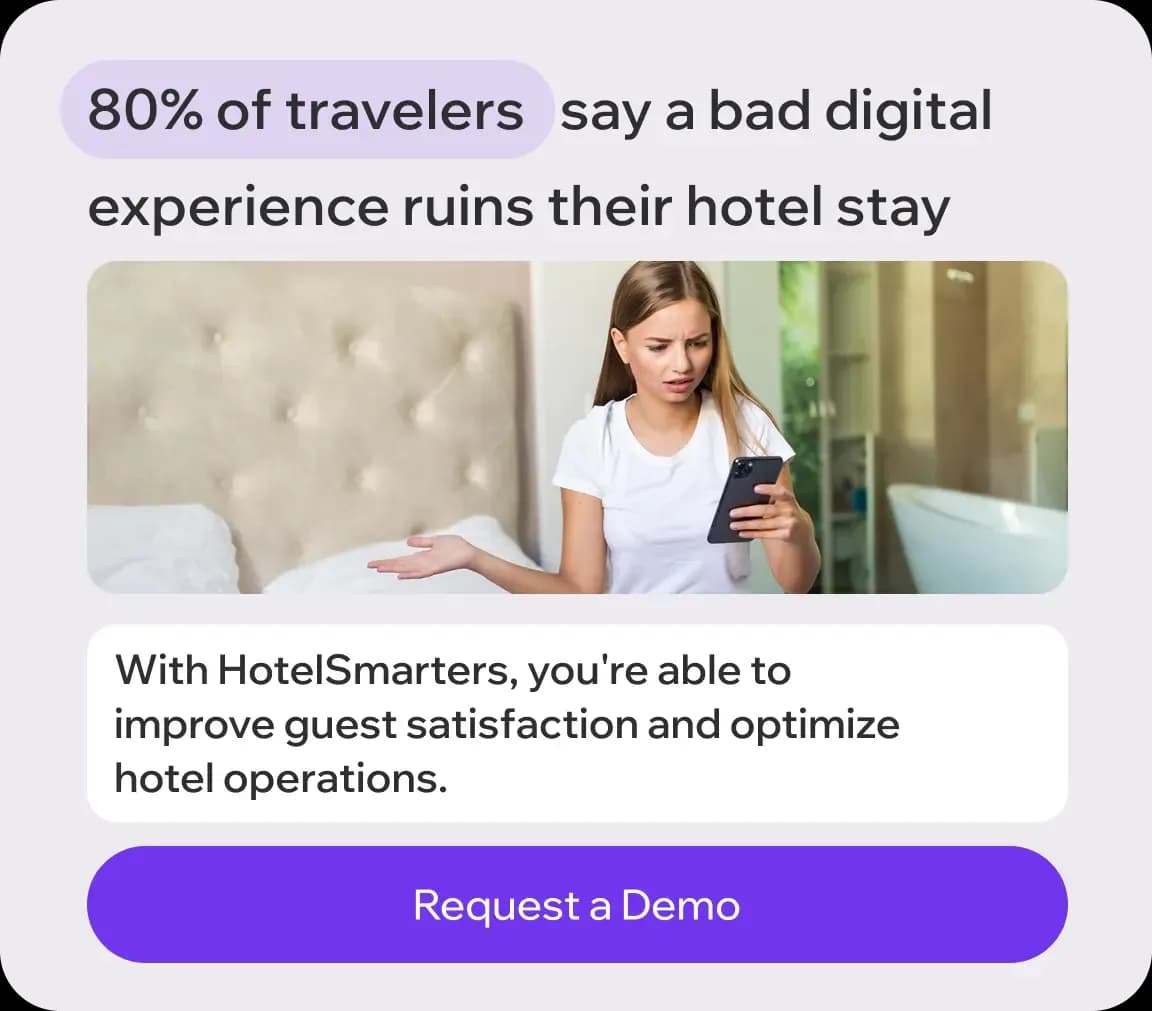
Your guest drops their bag, picks up the remote, and stares at a TV that does not know who they are. No watchlist, no profile, no familiar app grid. Just channels they will never watch. Within a minute they have given up and propped a phone against a water glass instead. That small moment of friction is exactly what a hotel casting system is built to remove.
A good hotel casting solution lets guests stream their own content on the big screen in seconds, with no setup and no compromise on security. The wrong one creates support tickets and complaints. This guide explains how hotel casting systems work and the specific features that separate a great one from a frustrating one.
A hotel casting system lets a guest send video, music, or photos from their personal phone, tablet, or laptop to the in-room TV.
Instead of logging into a hotel-owned account, the guest uses the apps and subscriptions they already pay for, then disconnects everything when they check out. The point is to recreate the at-home viewing experience inside your rooms, without asking the guest to learn anything new or hand over a password to a device they will never see again.
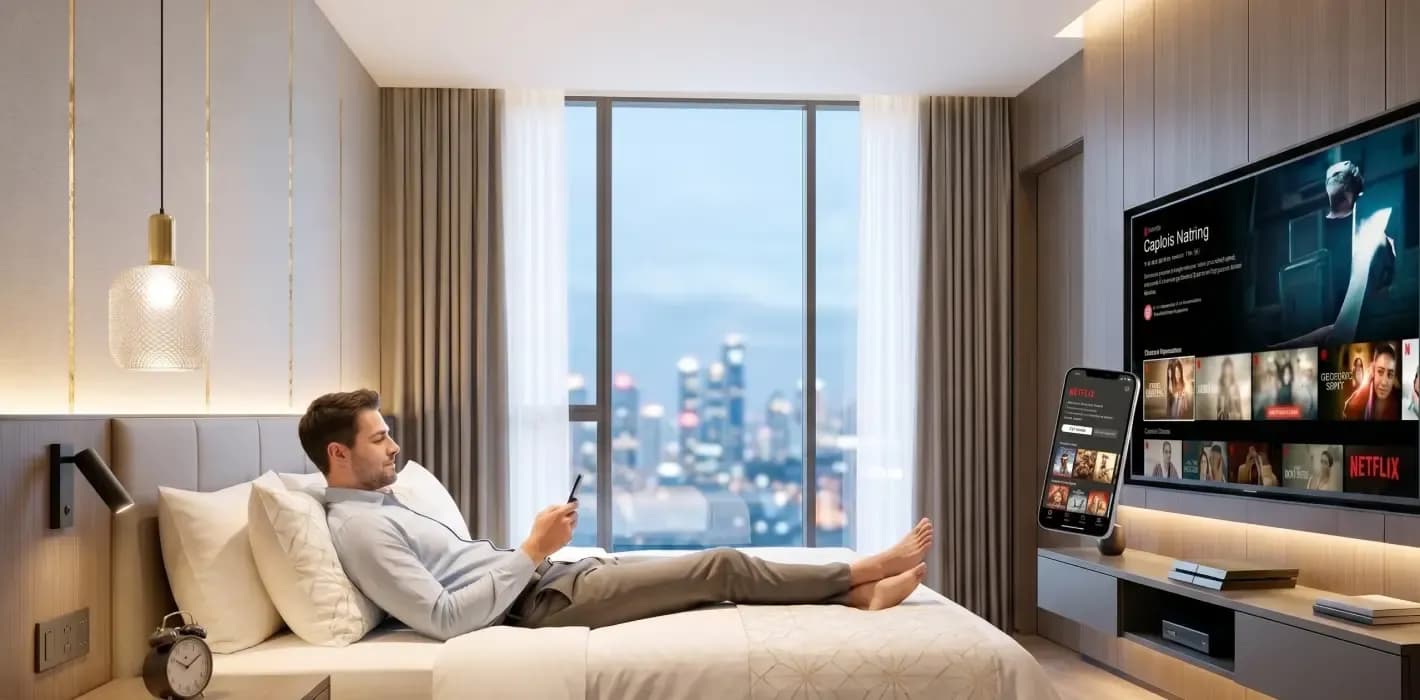
It helps to separate two things people often blur together. Casting sends a stream from an app to the TV, so the guest's phone tells the TV which Netflix episode or YouTube video to play and the TV pulls it directly. The phone effectively becomes a remote, which means the guest can keep texting or browsing while their show plays uninterrupted.
Screen mirroring copies whatever is on the device display onto the TV, which is useful for photos, slideshows, or a work presentation. Most modern hotel casting solutions support both, and the strongest hotel room casting setups make the choice invisible to the guest.
The hospitality version of this technology differs from the consumer gadgets people use at home in one important way: it is built for hundreds of rooms and thousands of strangers rather than a single household. That means it has to handle constant guest turnover, isolate each room from every other, and wipe personal data automatically, all without an IT team touching individual TVs. Those requirements are what separate a true hotel casting solution from a streaming stick plugged into the back of a screen.
Guest expectations have moved, and the data is clear. In the J.D. Power 2025 North America Hotel Guest Satisfaction Index, 40% of guests said a smart TV or the ability to stream content is a "need-to-have" amenity, and 60% said they used a smart TV during their stay. That is no longer a perk for tech-forward properties. It is a baseline.
The reason sits in your guests' pockets. People arrive with their own libraries, their own profiles, and a strong preference to keep watching what they were watching at home. A hotel TV that ignores all of that feels dated the moment it switches on.
The category is growing to meet that demand. The global hospitality TV market is estimated to be valued at approximately USD 4.71 Billion in 2026. The market is projected to reach USD 8.73 Billion by 2035, a clear signal that in-room entertainment is now a core part of how properties compete.
Casting is one of the most cost-effective ways to join that shift without replacing every screen in the building.
These three terms get used interchangeably, but they solve slightly different problems. Here is how they compare.
| Approach | What it does | Best for |
|---|---|---|
| Casting | The TV pulls a stream directly from an app selected on the guest's device | Netflix, YouTube, Disney+, and other on-demand streaming services |
| Screen mirroring | The TV displays an exact copy of the guest's screen | Photos, presentations, web browsing, and apps that do not support casting |
| Casting over IPTV | Casting functionality layered on top of an existing interactive TV or IPTV system | Properties that already offer live TV and on-demand content and want to add guest streaming |
Casting over IPTV is the option many hoteliers overlook. If you already run an interactive-TV system for live channels, on-demand movies, or in-room dining menus, casting does not have to replace it. It can be added as another layer the guest reaches from the same welcome screen, so streaming a personal account and browsing the hotel's own content live side by side. That avoids the false choice between a managed in-room platform and the personal streaming guests want.
The practical takeaway is that you should not have to choose. A capable hotel TV casting solution offers both casting and mirroring, and it can sit alongside an existing in-room TV platform rather than forcing a full rebuild. When you evaluate options, ask vendors to show you how their system behaves in all three modes, because a solution that does only one of them well will leave a gap your guests notice.
When you compare hotel casting solutions, the brand name matters far less than the capabilities underneath. These are the eight features that decide whether a system delights guests or generates complaints.
No-app, bring-your-own-device casting. The best systems let a guest cast straight from the apps already on their phone, with nothing to download and no account to create. If your staff have to walk guests through an install, you have already lost the experience. The test is simple: a first-time guest should be watching their own content within a minute of walking through the door, using the casting controls already built into their device. Anything that adds a QR code scavenger hunt or a six-digit pairing code typed with a remote is friction your front desk will hear about.
Support for guests' own streaming subscriptions. Guests want to log into their personal Netflix, YouTube, or Disney+ and watch their own profile, then have those credentials wiped at checkout. This matters more every year. Deloitte reports that 68% of streaming subscribers now use at least one ad-supported tier, up from 46% in 2024, so guests are juggling more services than ever and expect access to all of them. A system that supports only a handful of apps, or forces guests onto generic hotel accounts, misses the entire reason people want to cast in the first place. Look for broad app coverage and a login flow that never stores the guest's password on the TV itself.
Screen mirroring from phone and laptop. Beyond app casting, guests should be able to mirror a full device screen for photos, video calls, or a quick work session. Business travelers in particular treat this as essential, whether they are reviewing a deck on a larger screen or joining a call from the comfort of the room rather than the lobby. Confirm that mirroring works from both phones and laptops, and across both major mobile platforms, so you are not turning away half your guests by accident.
Security and guest data privacy. This is the feature that protects your brand. A strong system ends each casting session automatically at checkout, leaves no login credentials behind on the TV, and prevents content from one room leaking to another. Treat anything less as a liability, not a convenience. Picture the worst case: a guest checks out, the next guest powers on the TV, and the previous occupant's streaming account is still signed in. That single failure can turn into a privacy complaint, a chargeback dispute, or a public review. Automatic session teardown is not a nice-to-have; it is the line between a safe deployment and an ongoing risk.
Compatibility with your existing TVs and rooms. A retrofit-friendly casting layer that works with the screens you already own saves enormous capital. Ripping out every TV should be a last resort, not the starting point. Many properties can add casting to their current displays with a small device per room rather than a wholesale hardware swap, which keeps the project affordable and the rollout fast. Ask how the system handles a mixed fleet of TVs, since few hotels have identical screens in every room.
Reliable WiFi and bandwidth architecture. Casting lives and dies on the network. Look for per-room isolation, the ability to throttle bandwidth by room or guest tier, and clean separation between guest and staff networks. Without that foundation, buffering will undo every other feature. A full house streaming on a Friday night puts real strain on the network, so the system should manage capacity intelligently rather than letting a few heavy users degrade everyone else's experience. If a casting vendor cannot speak clearly about how it coexists with your WiFi, treat that as a warning sign.
Integration with your wider in-room stack. Casting is strongest when it works with your interactive TV, guest app, and property systems rather than as an island. Integration keeps the guest experience coherent and your operations simple. When casting, live TV, on-demand content, and hotel services all live behind one consistent interface, guests are not hunting across disconnected menus, and your team manages one platform instead of several. Property-aware integration also means the system can tie a session to the right room and end it cleanly at checkout.
Branding, multilingual support, and analytics. A welcome screen in the guest's language, your logo on the display, and usage data for your team turn a basic utility into a branded touchpoint you can actually measure. Multilingual support matters most for international properties, where a greeting in the guest's own language sets the tone before they have unpacked. Usage analytics, meanwhile, show you which features guests actually use, so you can justify the investment and refine what you offer over time.
The HotelSmarters Hotel Casting Solution is built around exactly these priorities. Guests can mirror the screen from their own phone or laptop, or log into their personal accounts on apps like Netflix, YouTube, and Disney+ and watch their own profiles on the room TV. Chromecast support means casting feels as familiar as it does at home, and built-in privacy protection prevents any cross-room content leakage, so one guest's session never reaches another room.
Because casting depends on a solid foundation, it pairs naturally with the rest of your in-room setup. A dependable Hotel WiFi network with guest and staff segmentation keeps streams smooth and secure, while Hotel Interactive TV brings live TV, on-demand content, and in-room services into the same screen experience.
See how the pieces fit your property and get in touch with us to talk through your rooms and network.
Narrowing the field is easier when you work through it in order.
The good news is that casting is one of the lower-risk upgrades you can make to in-room entertainment. It builds on devices guests already own, it can usually be added without replacing your TVs, and it delivers a visible improvement guests notice on their first night. Working through the criteria above in order keeps the decision grounded in your property's real needs rather than a feature checklist.
In-room entertainment is now part of how guests judge your property, and casting is the most direct way to meet that expectation without rebuilding every room. The HotelSmarters Hotel Casting Solution gives your guests the seamless, secure streaming they already expect at home. To map it to your rooms and network, get in touch with us.
A guest connects their phone, tablet, or laptop to the room's network, opens the app or screen they want to share, and selects the in-room TV as the destination. With a no-app system, this takes seconds and requires no setup from your staff.
A well-designed casting solution is. It should end every session automatically when the guest checks out, leave no login details on the TV, and keep each room's content fully isolated from every other room. Those protections are what make casting safe to offer at scale.
With the best hotel casting systems, no. Guests cast directly from the apps already on their devices, which removes friction and avoids support calls. Systems that force an install create exactly the hassle casting is meant to eliminate.
Casting tells the TV to pull a stream from a specific app, so the phone acts as a remote. Screen mirroring copies the entire device display to the TV. Casting suits streaming services, while mirroring suits photos, presentations, and apps that do not support casting.
Consumer Chromecast hardware was designed for homes, not multi-room properties, so it tends to struggle with privacy isolation and central management. A hospitality-grade casting solution delivers the same familiar experience with the security, scale, and control a hotel actually needs.

Content Manager
Anush Sargsyan is a content manager specializing in B2B content for the hospitality industry, with a focus on hotel technology and digital guest experiences. She creates informative, engaging content on hotel apps, smart room solutions, and modern hospitality innovations. Her goal is to help hoteliers and guests easily understand how technology enhances the stay experience.