May 31, 2026
Guest satisfaction in hotels is the clearest signal of whether your property is delivering on its promise. A single point improvement in your hotel's reputation score can let you raise room rates by 11.2% without losing occupancy - and a drop in satisfaction is just as fast to translate into negative reviews, cancelled return bookings, and lost revenue.
This guide covers what guest satisfaction means, how to measure it with the right tools, the strategies that move the needle, and how smart technology helps your team deliver consistently - every stay, every guest.
Guest satisfaction is the degree to which a guest's experience meets or exceeds what they expected when they booked. It covers every touchpoint - from the booking confirmation to the checkout - and reflects their overall impression of your service, your hotel amenities, and the people they interact with along the way.
According to a 2026 benchmark study by Shiji Group, tracking over 40 million reviews across 12,000 hotels globally, average hotel guest satisfaction reached 86.7% - a 0.5-point year-over-year gain continuing a trend that started in 2022. Hotels that improve their reputation score see a direct impact: a 1-point increase enables an 11.2% rate uplift without losing occupancy, and direct bookings rise by 14%.
High satisfaction drives loyalty and positive word-of-mouth. Low satisfaction drives the opposite - and in a market where guests post reviews publicly within hours, the gap between the two closes faster than ever.
Before tackling technology or strategy, the foundation of guest satisfaction is staff behavior. Three frameworks have become standard reference points in hotel operations training.
The 10-5-3 Rule: When a guest is 10 feet away, acknowledge their presence with eye contact. At 5 feet, smile. At 3 feet, greet them verbally. The rule creates consistent, human-first interactions that guests notice - even if they can't articulate why the service felt warm.
The 15/5 Rule: Acknowledge a guest at 15 feet with eye contact and a nod, then greet them with a verbal hello at 5 feet. Some properties use this as a lighter alternative to 10-5-3 in high-traffic areas like lobbies and corridors.
The 3 C's of Customer Satisfaction: Consistency, Courtesy, and Communication. Consistency means guests get the same quality experience regardless of which staff member helps them or what shift it is. Courtesy means guests are treated with warmth and respect at every interaction. Communication means information flows clearly - check-in instructions, room details, service requests - without guests having to ask twice.
These are the behavioral standards that technology can support and scale, but cannot replace.
Understanding guest satisfaction requires more than tracking a single number. It means using multiple measurement tools together to build a complete picture - and then acting on what you find.
Surveys are the most direct feedback channel you have. Whether delivered at check-out, via post-stay email, or through a hotel guest app, they help you pinpoint what worked and what needs fixing. Standard survey areas include room cleanliness, staff friendliness, quality of amenities, and overall satisfaction.
NPS measures loyalty: how likely are guests to recommend your hotel to someone else? Guests score their stay from 0 to 10 and fall into three groups:
NPS formula: % Promoters - % Detractors = NPS
| Step | Calculation | Formula |
|---|---|---|
| Step 1 | Find Promoters % | (Number of Promoters ÷ Total Respondents) × 100 |
| Step 2 | Find Detractors % | (Number of Detractors ÷ Total Respondents) × 100 |
| Step 3 | NPS Score | % Promoters − % Detractors |
For example, if 60% are Promoters and 20% are Detractors, your NPS is 40. A score above 0 is considered good; above 50 is excellent.
Hotel NPS benchmarks vary by segment: luxury properties typically target 60+, while mid-scale properties aim for 40-50. Tracking your NPS monthly - and comparing it to your segment average - gives you a faster signal than waiting for annual review summaries.
Two additional scores round out a proper measurement framework:
CSAT (Customer Satisfaction Score) measures satisfaction with a specific interaction or touchpoint - how was the check-in experience, how was the spa, how was the breakfast? It asks guests to rate satisfaction directly on a 1-5 or 1-10 scale. CSAT is best used at the interaction level, not as an overall property score.
CES (Customer Effort Score) asks a different question: how easy was it for the guest to get what they needed? High effort - having to call the front desk three times to resolve a billing issue, or waiting 20 minutes for a room service order - drives dissatisfaction even when the underlying service quality is high. Hotels that score well on CES typically have streamlined digital service channels.
Review platforms - TripAdvisor, Booking.com, Google - are where your reputation is built in public. Monitoring and responding to reviews is part of hotel feedback system management, not optional extra work. Guests share more candidly on review platforms and social media than they do in post-stay surveys, which makes these channels valuable for spotting recurring issues.
Catching problems during a stay - not after check-out - is the highest-leverage moment you have. Smart room technology enables real-time feedback loops: guests can flag issues from their in-room tablet or guest app without having to walk to the front desk, and your team can respond before the stay ends and the review gets written.
Personalization is one of the most consistent drivers of higher satisfaction scores. Guests value experiences that feel tailored to them - remembering preferences from previous stays, offering welcome amenities that match their profile, or recommending activities they're likely to enjoy.
Simple gestures drive outsized results:
A well-trained team is the foundation of guest satisfaction. Research consistently links employee satisfaction and guest experience - staff who feel valued provide better service, which creates better stays. Investing in your team's skills and culture is one of the highest-ROI levers you can pull.
Key training areas to prioritize:
Your review response strategy is part of your guest satisfaction work - not separate from it. When guests see that your hotel responds to criticism thoughtfully and promptly, it signals that their feedback is taken seriously.
A practical review response workflow:
Consistency is the "C" in the 3 C's that guests notice most. Regular room inspections, staff performance reviews, and satisfaction survey analysis help you identify when standards drift and fix them before they compound. Use your CSAT data at the touchpoint level to find the specific interactions dragging down your overall score.
Collecting feedback only has value if you close the loop. Show guests - and your team - that feedback drives real changes:
Technology has become one of the most controllable levers hoteliers have for improving satisfaction - because unlike staff turnover or renovation timelines, it can be deployed quickly and measured almost immediately.
HotelSmarters offers three tools that directly affect guest satisfaction scores:
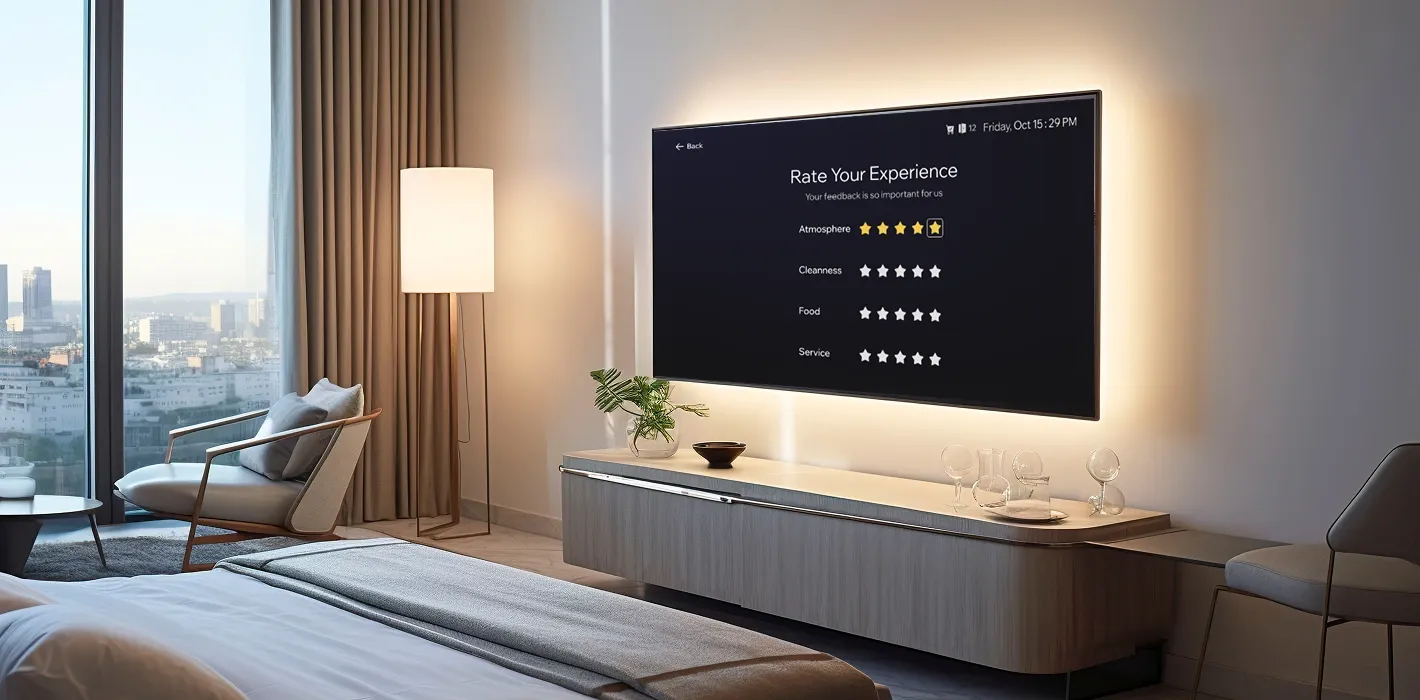
The Hotel Interactive TV lets you display feedback forms at checkout, push personalized welcome messages and room-specific notifications, and give guests frictionless access to streaming services through a fully managed smart TV platform. Guests who encounter seamless in-room entertainment and receive personalized acknowledgment consistently rate their stays higher on post-stay surveys.
The Guest App puts service requests, pre-arrival communication, and post-stay feedback collection into a single mobile interface. Guests can flag a maintenance issue, request an extra pillow, or complete a satisfaction survey without calling the front desk or waiting for anyone to be available.
Hotel In-Room Tablets bring the same functionality bedside - room service ordering, concierge access, and real-time feedback - with a dedicated device that doubles as a real-time feedback channel. Issues captured in-stay, before checkout, are the ones you can still resolve.
The combined result: fewer complaints escalate to online reviews, more feedback is captured when it is still actionable, and guests leave with the impression that your hotel runs efficiently and actually listens.
Get in touch with HotelSmarters to see how these tools fit your property.
Even well-run hotels face consistent obstacles. Recognizing them is the first step to building systems that mitigate them:
The trends shaping guest satisfaction over the next 3-5 years are already visible in early-adopter properties. Hotels that get ahead of them now will have a structural advantage.
AI in hospitality is moving beyond chatbots to genuine personalization at scale. In 2026, eight out of ten travelers report wanting AI assistance during their booking and stay journey. AI-driven systems can tailor room recommendations based on past stays, adjust service offers in real time based on a guest's in-property behavior, and power 24/7 concierge responses that feel relevant rather than templated.
Hotel room lighting, temperature, and entertainment controlled by voice are moving from luxury-only to mainstream. 57% of travelers prefer voice assistants for in-room controls, and hotels that offer this feel noticeably more modern to the guests who value it.
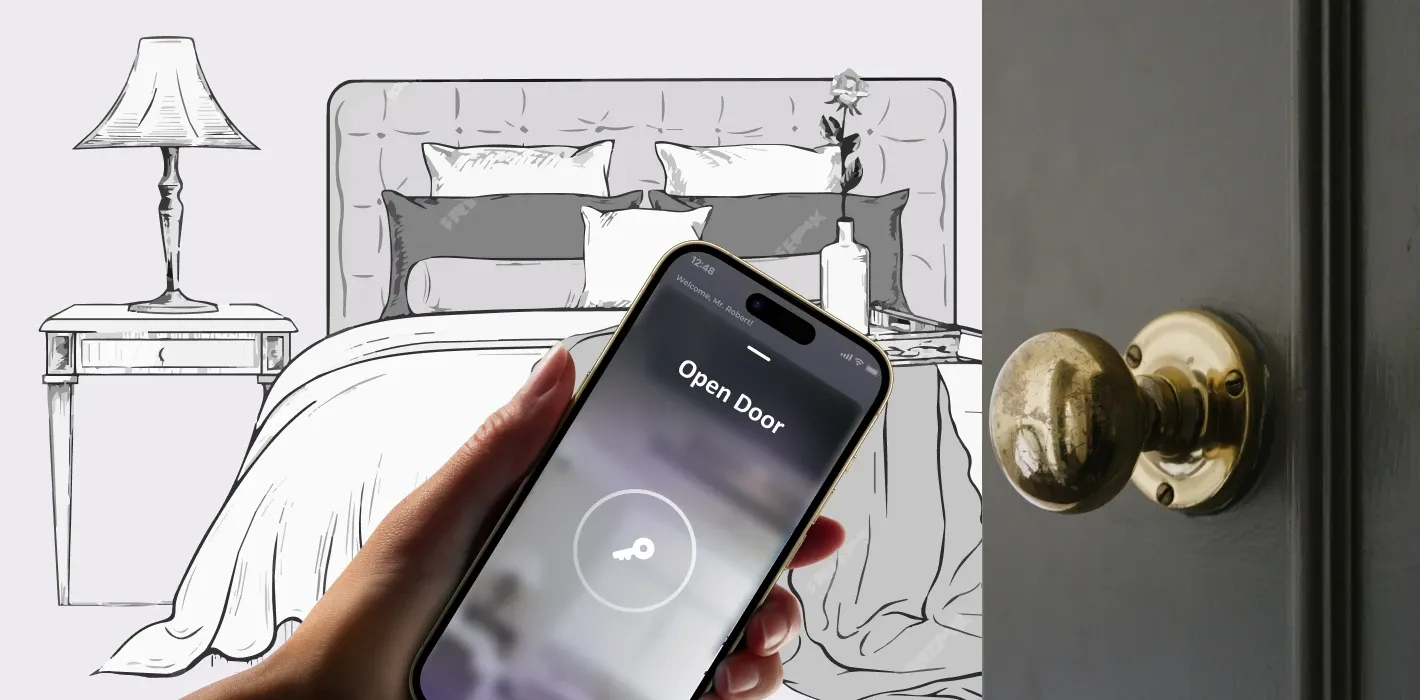
Keyless entry, mobile check-in, and app-based service requests are now expected in mid-scale and above properties. Hotels that still require physical key cards and front-desk-only check-in are creating friction points that guests compare unfavorably to properties that don't.
Eco-conscious guests - a growing share of the market - rate their satisfaction partly on whether your property demonstrates measurable environmental commitments. Smart hotel room lighting and automated energy management reduce costs and satisfy this guest segment simultaneously.
Travelers increasingly prioritize physical and mental wellbeing when choosing a property. Hotels that integrate wellness offerings - fitness centers, spa access, healthy dining options, sleep-focused room environments - see measurable satisfaction uplift from the guest segments that care about this.
Guest satisfaction is the most direct measure of whether your hotel is delivering on what it promises - and the most reliable predictor of repeat bookings, positive reviews, and sustainable revenue growth. The fundamentals are human: service standards, staff training, and acting on feedback. The differentiator in 2026 is technology that makes those fundamentals consistently achievable at scale.
HotelSmarters' suite of smart hotel solutions - from interactive in-room TV and guest apps to casting, digital signage, and hotel Wi-Fi - is designed to reduce friction at every point in the guest journey. If you're ready to improve your guest satisfaction scores, get in touch with us and discover what the right setup looks like for your property.
Guest satisfaction in a hotel measures how well the property's service, amenities, and overall experience met or exceeded what the guest expected when they booked. It encompasses every touchpoint from booking to check-out and directly influences whether guests return, recommend the hotel, and leave positive reviews.
Hotels typically measure guest satisfaction using a combination of post-stay surveys, Net Promoter Score (NPS), CSAT (satisfaction rating at specific touchpoints), Customer Effort Score (CES), and ongoing monitoring of online review platforms. Using multiple metrics together gives a more complete picture than any single score.
The 10-5-3 rule is a guest interaction standard: acknowledge a guest with eye contact at 10 feet, smile at 5 feet, and greet them verbally at 3 feet. It creates a consistent, warm service experience and is widely used in hotel staff training to standardize how front-line employees engage with guests.
The 15/5 rule is a service standard used in hotel training: acknowledge a guest with eye contact and a nod at 15 feet, then greet them verbally at 5 feet. Some properties use this as a lighter version of the 10-5-3 rule, particularly in high-traffic public spaces.
Technology improves guest satisfaction by reducing friction and enabling personalization at scale. Interactive in-room TVs let guests control entertainment and request services without calling the front desk. Mobile apps enable check-in, service ordering, and real-time feedback from a guest's phone. In-room tablets provide digital concierge access. Hotel Wi-Fi ensures seamless connectivity throughout the property. Together, these tools allow guests to manage their own experience while freeing your team to focus on high-value service interactions.
The 3 C's are Consistency, Courtesy, and Communication. Consistency means guests receive the same quality of service regardless of the staff member or shift. Courtesy refers to warmth and respect in every interaction. Communication means information - about check-in, services, requests - flows clearly without guests needing to ask multiple times.

Product Manager
Leads smart hotel tech products. Focused on interactive TV and PMS integrations. Turns guest needs into simple, effective solutions. Loves building products that improve hotel operations and enhance guest experience.