August 18, 2026
Your guests judge your hotel long before they arrive. They read your reviews on their phone, compare your rating to the property down the street, and decide in seconds whether you are worth the money. That verdict is your reputation, and it now sits between you and almost every booking. Handle it well and your reviews become your best salesperson. Ignore it and a handful of unanswered complaints quietly drains bookings and pricing power.
Hotel reputation management is how you take control of that verdict - monitoring what guests say, responding the right way, earning more and better reviews, and fixing the problems that cause bad ones in the first place. This guide walks you through all of it, with 2026 data and practical steps your team can use this week.
Hotel reputation management is the ongoing practice of monitoring, influencing, and improving how your property is perceived across review sites, online travel agencies, social media, and search results.
In plain terms, it is the work of shaping what a potential guest finds - and feels - when they look you up.
It is easy to treat this as the same thing as review management, but reputation is the bigger picture. Reviews are one input; your reputation is the whole impression that forms from your ratings, your responses, your photos, your social presence, and the way guests talk about you. Reputation management for hotels means owning all of that on purpose, rather than letting it happen to you.
Why does this matter more now than it did five years ago? Because the search has moved onto the phone in your guest's hand, the number of places they can check has multiplied, and a single low score sits in public view for years. Reputation management is simply the discipline of making sure that what they find works in your favor.
Reputation is not a soft metric. It is a revenue lever, and the numbers make the case plainly. In a 2026 analysis of roughly 1,400 guest reviews across major hotel brands, 92% of guests said they read reviews before booking a hotel (Alchemer, 2026). Your rating is the filter almost every guest applies before they ever reach your booking engine.
It also shapes what you can charge. The same research found that 86% of guests would pay more for a superior experience, and a strong reputation is how they decide, in advance, that yours is worth it. Landmark Cornell University research put a number on the effect: a one-point gain in a hotel's reputation score can lift revenue per available room by roughly 1.4% (Cornell Hospitality Research). Spread across a full property and a full year, that is real money tied directly to how you are perceived.
For the wider hotel industry, reputation management has moved from a marketing nicety to a core commercial discipline. A rating point is now a pricing input. A bad review left to sit is a run of bookings you simply never see. And for a group or brand, consistent hotel brand reputation management across every property is what keeps one weak location from dragging down the trust in your name.
Managing your online reputation starts with knowing where the conversation happens - and in 2026 it happens in more places, and more often, than ever. Hotel review volume grew 2.1% year over year in the latest global benchmark, with five-star properties seeing a record 4.4% jump, while the industry's global guest satisfaction index reached a record 86.7% (Shiji, 2026). The bar your guests measure you against keeps rising.
The bigger shift is where those reviews land. Google has overtaken TripAdvisor as the leading source of hotel reviews, with 12.4 million mentions against TripAdvisor's 10.3 million in that same benchmark. For hotel online reputation management, that means your Google Business Profile is no longer optional housekeeping - it is the front page of your reputation. Social channels matter too: a guest who tags your property in a post or a story is shaping your reputation just as surely as a formal review, so the picture is wider than the review sites alone.
Here is where to focus your attention:
| Platform | Why it matters | What to prioritize |
|---|---|---|
| The first thing guests see in search and Maps, and now the largest review source | Keep your Business Profile complete and current; reply to every review | |
| Booking.com and Expedia | Reviews sit next to your rate at the moment of decision, and come only from verified guests | Track your score closely; a small dip here costs bookings fast |
| TripAdvisor | Still a major research destination, especially for leisure travelers | Keep your listing accurate; respond publicly and professionally |
| Your post-stay survey | Private feedback you see before it ever goes public | Use it to catch and fix issues early |
Good hotel review management is a routine, not a fire drill. These four steps turn scattered reactions into a system your team can run every week.
The cheapest review to manage is the bad one that never gets written. Nearly half of guests, 48%, leave a review after a bad experience, so the surest way to protect your rating is to catch friction while the guest is still in the building - not after they have checked out and gone public.
That is where the in-stay experience does quiet work for your reputation. When guests have an easy, immediate way to tell you the room is too warm or the towels never arrived, you get the chance to fix it, and a rescued stay often becomes a good review instead of a bad one.
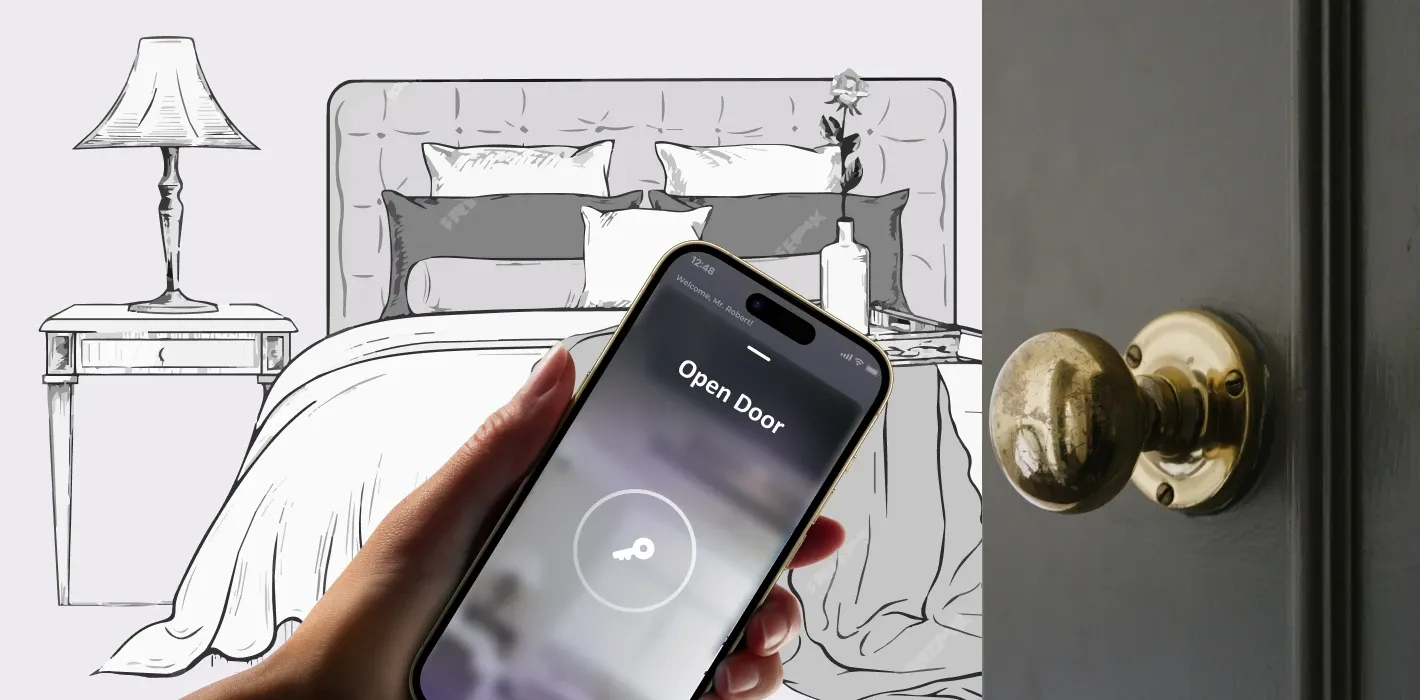
The technology in the room is part of this. A guest app lets guests message the front desk, request service, and flag a problem from their own phone the moment it happens. In-room tablets put those same one-tap requests and service ordering right by the bed. An interactive TV turns the screen every guest already uses into a channel for information, offers, and easy contact with your team. And clear digital signage around the property removes the small confusions - where breakfast is served, when the spa opens - that quietly add up to a frustrated guest.
None of this manages your reviews for you. What it does is strip out the everyday friction that turns an average stay into a one-star story. See how a better in-room experience can protect your rating - get in touch with our team.
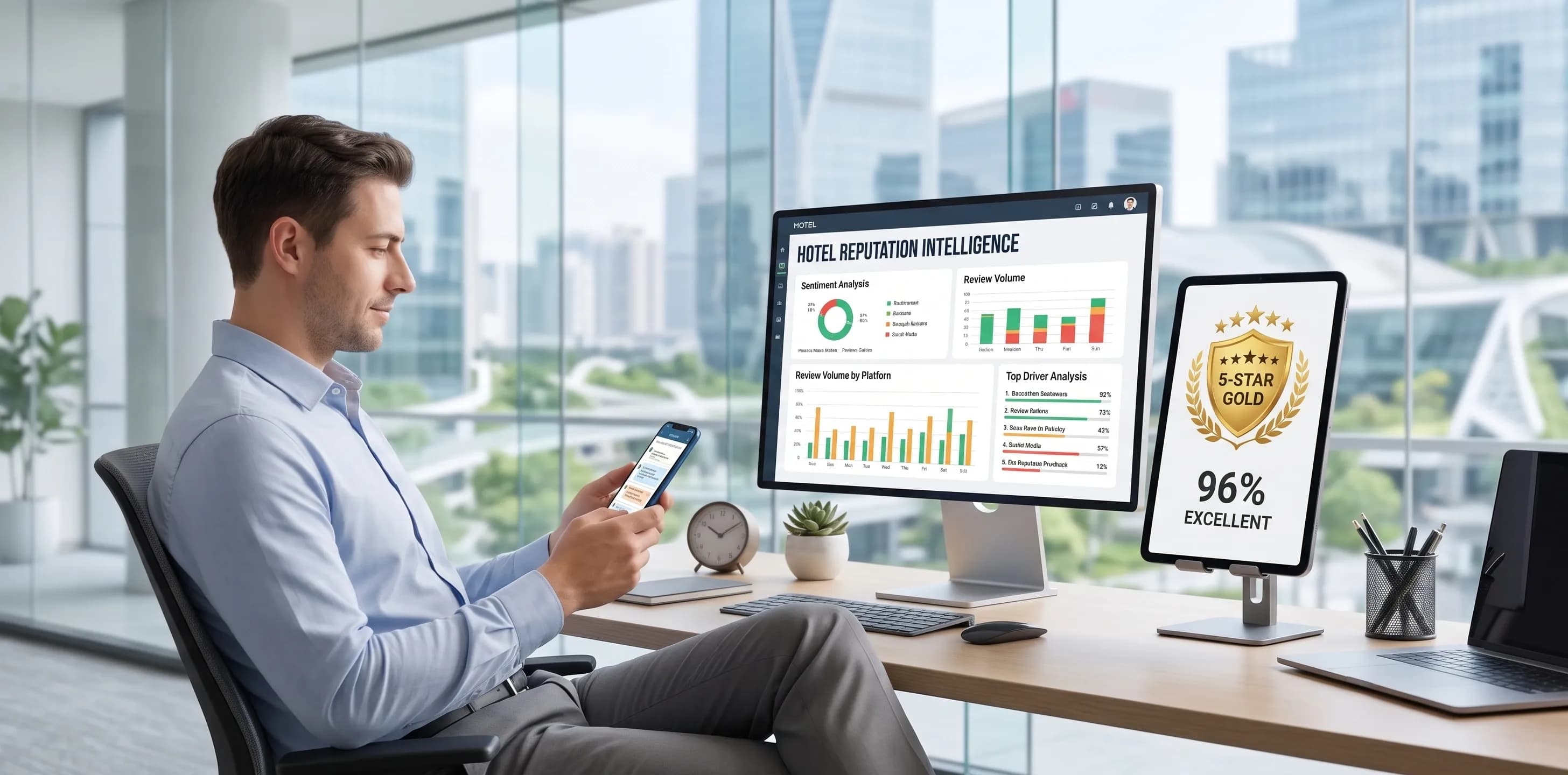
As review volume grows, most hotels reach a point where spreadsheets and manual checking stop scaling. That is when hotel reputation management software earns its place. You do not need to memorize vendor names to shop well; you need to know what the category should do for you. A capable hotel reputation management system usually covers five things:
Artificial intelligence is reshaping these tools quickly. In 2026, 85% of hotel technology decision-makers plan to put at least 5% of their IT budget into AI tools, 82% expect their AI use to grow over the next year, and 71% already say AI is having a significant or transformative impact on the business (Canary Technologies, 2026). For reputation work, AI now drafts review replies in seconds and summarizes what hundreds of guests are really saying. Use it, but keep a person in the loop. AI-generated review summaries have been caught glossing over serious complaints, so someone on your team should still sign off on tone and accuracy before anything reaches a guest.
Even well-run hotels lose ground to a handful of avoidable habits. Watch for these:
Avoiding these five is often the fastest way to move your score, because it costs nothing but attention.
Track a small set of numbers so you know the effort is paying off:
When those move in the right direction together, your reputation strategy is working, and your bookings and rates will usually follow.
Your reputation is earned twice - once in the room, and once in how you answer the guest who talks about it. Get both right and every new review compounds the last. Start by responding to what is already out there this week, then build the routine that keeps it strong. When you are ready to see how a better in-room experience can protect the rating you work so hard for, explore the platform or get in touch with us.

Product Manager
Leads smart hotel tech products. Focused on interactive TV and PMS integrations. Turns guest needs into simple, effective solutions. Loves building products that improve hotel operations and enhance guest experience.