October 2, 2026
Your front desk knows the guest in 412 asked for a late checkout. Housekeeping does not. Your email platform sends her a generic post-stay survey three days later, and she leaves a seven out of ten.
Nothing broke. The information simply never traveled.
That is the problem guest experience management is supposed to solve, and it is why a drawer full of good tools so often produces an average score. This article covers what a guest experience management system is, the five stages it spans, who runs it inside your hotel, what it costs, and how you tell whether it is working.

Guest experience management is the practice of tracking, connecting, and improving every interaction a guest has with your hotel, from the first booking confirmation to the review they leave a week after checkout. Guest experience itself is the sum of those interactions as the guest felt them, not as your systems recorded them. Guest service experience is the narrower term sitting inside it: the quality of one served moment, the check-in or the room service delivery, where guest experience covers the whole arc including the parts no staff member touches.
The distinction that matters in practice is this: hospitality guest experience management is a system and a discipline, not a set of good intentions. Four things have to be true before you have one.
Miss one and you have tools. Hold all four and you have a system.
The hotel guest experience journey runs across five stages, sometimes called the guest experience cycle, and each one has its own failure mode. Mapping your current setup against all five is the fastest way to find where you are losing score.
Pre-arrival is where expectations get set. Targeted pre-stay messages, personalized booking confirmations, upgrade offers, and a simple way to flag an early arrival all land here. A preference captured here is worth more than one captured later, because every stage after it can act on it.
Arrival is the stage guests judge hardest and remember longest. Contactless check-in, a greeting by name, a room ready when promised, and a bag handled without a second ask all set the tone for everything after. Arrival friction is expensive because it is the first thing that happens.
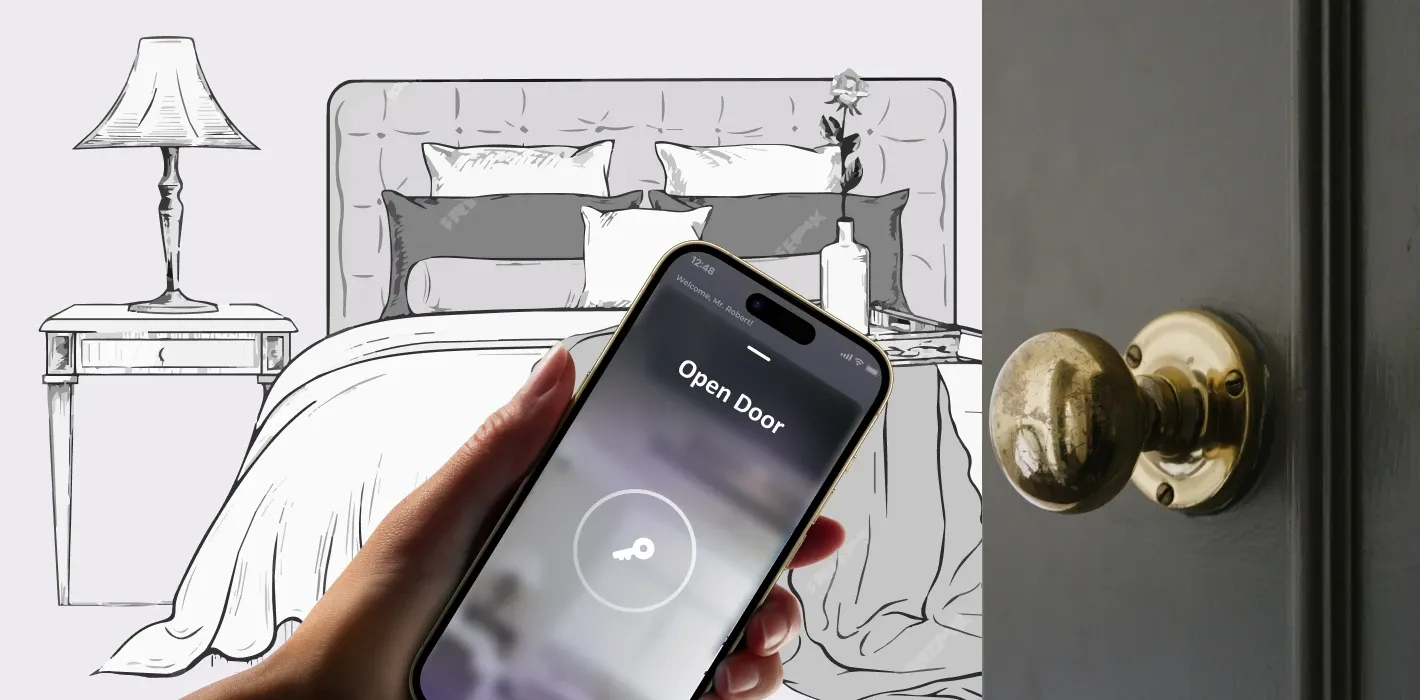
A contactless guest experience is what most properties are now building toward at this stage: the guest checks in on their phone and reaches the room without queuing. Be precise about what it fixes. Contactless removes the queue, but it also removes the moment a front desk agent would have caught a preference, so the profile layer has to carry what the conversation used to.
The stay is the longest stage and the least instrumented. Room service, housekeeping requests, spa bookings, restaurant reservations, and the in-room systems a guest touches every evening all sit here. Most hotels have good data on the fifteen minutes at the desk and almost none on the forty hours in the room.
Departure is the stage most hotels do not treat as a stage at all, and it is where a good stay loses its rating. A folio charge the guest does not recognize, a checkout queue at eleven, a late transfer - each overwrites three days of competent service in the thirty minutes before the guest walks out. Instrument this stage and you protect the score you already earned.
Post-stay is where the experience becomes a public asset or a public liability. Thank-you messages, a feedback request timed while memory is fresh, a response to the review that lands, and an offer shaped by what the guest actually did all belong here. For practical ways to improve the guest experience at each stage, we cover the tactics separately.
Guest experience management needs a named owner, and in most properties it does not have one. The title you will see on larger teams is guest experience manager or guest experience lead, and the role sits across departments rather than inside one.
In practice, that person is responsible for:
In a property too small for the title, this lands on the front office or duty manager by default. That is workable. What is not is the common alternative, where marketing owns the pre-stay messages, operations owns the stay, and nobody owns the handoff.
Ownership fragmentation, not software quality, is the most common reason a guest experience program stalls in its first year.
A guest experience management system is the connected set of software layers that carries a single guest profile across all five stages and turns what guests tell you into work your staff can do. The shorter guest experience system means the same thing. Guest experience software and the digital guest experience platform label describe it at different scopes: a platform usually bundles the profile and communication layers into one product with the rest integrated around it, while software can mean any single layer sold on its own.
There are five layers, and the architecture matters more than any individual product in it.
The profile layer holds who the guest is and what they prefer. This is the layer that has to survive between stages, and it is where most stacks fail.
The communication layer carries messages across email, SMS, chat, and in-room channels without starting a new thread each time.
The feedback layer collects structured input at points you chose, during the stay as well as after.
The in-room layer reaches the guest in the one place the rest of the stack cannot.
The operations layer turns a request into a task with an owner, a timestamp, and a confirmation.
A profile that does not travel between stages is the canonical failure. The guest tells you at booking that she is allergic to feather pillows, then tells you again on night two, because the second system never saw the first.
Digital guest experience management tools fall into six categories, and most hotels already own three or four without having connected them. The table shows what each does, which stages it reaches, and what it has to talk to.
| Tool category | What it does | Stages it touches | Must integrate with |
|---|---|---|---|
| Guest profile and CRM | Stores identity, history, preferences | All five | PMS, booking engine |
| Chat and AI assistants | Answers routine questions, escalates the rest | Pre-arrival, stay | Profile layer, operations |
| Feedback and review management | Collects and routes guest input | Stay, departure, post-stay | Operations, profile layer |
| In-room systems | Delivers service and content where the guest spends most time | Stay | PMS, operations, F&B |
| Guest app | Puts requests and information in the guest's pocket | All five | Profile layer, operations |
| Property-wide displays | Wayfinding, events, offers in public areas | Arrival, stay, departure | Operations, F&B |
Notice what the right-hand column has in common. Every category depends on something it does not own, which is why the integration question decides more than the feature comparison does.
The in-room layer is the part of guest experience management that reaches the hours no other system sees. A guest spends fifteen minutes at your front desk and most of the stay in the room, where in-room entertainment has stopped being optional. J.D. Power's 2026 North America Hotel Guest Satisfaction Index found smart TVs with streaming at 74% availability and 62% guest usage, both up two points year over year. Streaming has crossed from premium amenity to baseline expectation.
HotelSmarters covers this layer. Hotel Interactive TV puts in-room dining, spa and wellness, bar and restaurant, promotions, live TV, movies, music, flight information, and transfer reservations on the screen the guest is already looking at, so a service request becomes two clicks instead of a phone call. The Hotel Guest App adds room controls, transfers, an alarm, multilingual support for guest personalization, and an analytics dashboard showing what guests actually used. In-room tablets carry the same feature set at the bedside. Hotel casting lets a guest mirror a phone or laptop and sign in to a personal streaming account, with no content leaking between rooms.
Want to see how the in-room layer fits your property? Get in touch with us for a walkthrough.
Integration is the most common failure point in guest experience management, and hoteliers say so themselves. In the 2026 Hotel Technology Outlook from the NYU Tisch Center of Hospitality, 38% named integration as a top pain point and 51% planned to replace or upgrade their stack within twelve to twenty-four months.
The consequences show up in front of the guest, not in the back office. Properties on all-in-one platforms reported missed guest preferences at 51% against 41% for best-in-class stacks, and check-in delays at 46% against 23%. Those are guest experience failures produced by architecture, not by staff.
Three questions settle most of this before you sign:
Guest experience management costs are quoted in several shapes, and the shape matters as much as the number. Vendors rarely publish hospitality prices, so what is worth understanding before you take a call is the structure of the quote.
The budget conversation is already happening at most properties. According to Hotel Dive, 52% of hoteliers name improving guest experience as a top driver of technology investment, level with efficiency and ahead of revenue growth at 51%.
Ask for the three-year total in writing, integration and hardware replacement included. A quote covering only licensing is not a quote.
Property size changes which guest experience management stack is right, and hoteliers already behave accordingly. Among hotels with more than 100 rooms, 68% run best-in-class systems chosen layer by layer, while 54% of properties with 100 rooms or fewer run a single all-in-one platform. Both choices are rational at their own scale.
Under 100 rooms. One platform that does most things adequately beats four that each do one thing well, because you do not have the staff to manage four vendor relationships. Accept the ceiling, and make sure the in-room layer is not what you give up.
100 rooms and above, or a group. Best-in-class becomes worth the integration overhead, because the cost of a weak layer multiplies across properties. Standardize the profile layer first and let the rest vary.
Resorts, serviced apartments, and extended-stay. Guests spend far more time in the room, so the in-room layer carries more of the journey than in a city-center business hotel. Weight your spend accordingly.
Rolling out guest experience management works best as a sequence, not a launch. Six steps cover it.
Measuring guest experience management means picking the right metric for the stage you are working on. The four in common use answer different questions.
| Metric | What it measures | Best used for |
|---|---|---|
| Guest Satisfaction Score (GSS) | Overall satisfaction with the stay | Property-level trend |
| Net Promoter Score (NPS) | Likelihood to recommend | Loyalty and brand strength |
| Customer Satisfaction Score (CSAT) | Satisfaction with one interaction | A single stage or fix |
| Review score | Public sentiment on OTAs and review sites | Commercial impact, rate power |
A guest experience survey is how three of those four get collected, and the design decides their quality: short, timed to the stage you are measuring, and sent while the guest can still remember what you asked about. Reach for CSAT when you are fixing a specific stage, because it isolates the interaction you changed. GSS and NPS move too slowly to tell you whether last month's change worked.
For a benchmark, J.D. Power put North American guest satisfaction at 665 on a 1,000-point scale in 2026, up 13 points across 44,787 guests and 104 brands. That is the line to sit your own guest satisfaction score against.
One change makes measurement more urgent. Booking.com now weights recent reviews far more heavily than its former three-year average, as Hospitality Net reported in January 2026. One analyzed property held an 8.8 for 480 consecutive days under the old model, then recorded fifteen score changes in eight months after the update. A service fix now reaches your public score in months rather than years, which makes the post-stay stage and your reputation management worth instrumenting properly.
Three obstacles come up in nearly every guest experience management rollout, all manageable if you plan for them.
The hotels that get this right are rarely the ones with the most tools. They are the ones where someone owns the journey, the profile follows the guest, and the room is part of the system rather than an afterthought.
HotelSmarters builds the in-room layer that the rest of your stack cannot reach. Tell us about your property and we will show you where it fits - get in touch with us.

Product Manager
Leads smart hotel tech products. Focused on interactive TV and PMS integrations. Turns guest needs into simple, effective solutions. Loves building products that improve hotel operations and enhance guest experience.