January 30, 2026
To provide ultimate guest satisfaction, you need personalization. To personalize your guests' stays, you need to know more than their names and room numbers.
That's where you must use rooming lists: the files full of information on what your guests want.
This article digs deep into everything you need to know about hotel rooming lists. Whether you manage a 40‑room boutique property or a 2,000‑room convention hotel, this guide will come in handy.
Let's start from the basics.
A rooming list is the core operational document for any group booking of roughly ten or more rooms, though many hotels now create lists even for smaller VIP blocks to ensure individualized service.
This document includes more than guest names. Arrival and departure dates, room types, billing instructions, loyalty numbers, special requests, and any shoulder nights or extensions are included in a rooming list.
At its simplest, a rooming list is a roster of guests within a single group reservation. It tells you who is staying in which room on which dates under which payment arrangement.
Each rooming list corresponds to an individual reservation, helping you turn guest data into flawless and personalized service.
A rooming list is more than just a list of names. It's the tool that helps your hotel manage group stays smoothly and avoid last-minute confusion.
It brings group bookings together
Instead of handling dozens of separate reservations, a rooming list groups them under one event or reference, making everything easier to track and manage.
It captures the details that matter
Along with guest names and dates, it includes important information like loyalty numbers, special needs, dietary preferences, and VIP status-so nothing is missed.
It's always evolving
Group plans change. A good rooming list allows updates right up until arrival, and sometimes even during the stay, keeping your team aligned at all times.
It supports every department
From reservations and front desk to housekeeping, banquets, security, and finance, everyone relies on the rooming list to do their job properly.
We must note that rooming lists are needed for corporate events, group tours, sports teams, school trips, religious groups, government visits, family gatherings, touring crews… the list goes on.
In every case, they reduce guesswork, protect room inventory, and ensure both the client and hotel are on the same page.
Plus, every hotel department touches the rooming list: sales negotiates it, reservations loads it, front office verifies it, housekeeping stages rooms from it, and finance audits revenue against it.
Sounds like no hotel can survive without rooming lists. Not to scare you, but that's true. But no need to freak out, read on, we have the solution.
Practice makes perfect, well, at least it helps us understand and remember new concepts. So, let's imagine we have a group reservation to create a rooming list for.
Here is the structure:
Housing each element in a predictable column layout makes important information accessible to your staff members, whenever and wherever they need it.

As mentioned above, a rooming list doesn't live in just one department. It's needed for every operation.
Once it's created, it becomes a shared tool that helps every team work faster and more accurately.
Sales and Events
Your sales team uses the rooming list to manage group size, rates, and deadlines. It helps them track pickup progress, spot underperforming blocks early, and adjust strategy before rooms go unsold.
Reservations
When the list arrives, reservations load it into the system, clean up duplicates, attach loyalty details, and prepare pre-arrival communications. It also helps them catch special cases, like early arrivals or VIP requests, before guests show up.
Front Office
On check-in day, the rooming list becomes your front desk roadmap. Guest details are already in the system, so staff can check guests in faster, avoid manual entry, and deliver welcome amenities without delay.
Housekeeping
Housekeeping relies on the list to plan the day. It shows where early check-ins, late check-outs, room moves, or special setups are needed-helping supervisors assign staff efficiently and avoid last-minute pressure.
Banquets and Culinary
Guest counts and dietary needs come directly from the rooming list. This ensures the right number of meals, coffee breaks, and seating-without last-minute surprises or missed special requests.
Security and Engineering
The list helps identify when extra security is needed, such as for VIPs or large groups, and allows engineering teams to schedule maintenance around peak arrival times.
Finance
After checkout, finance uses the final rooming list to reconcile billing, apply attrition rules, confirm no-shows, honor tax exemptions, and verify approved upgrades-protecting revenue and avoiding errors.
These were the main hotel teams that needed rooming lists to do their jobs efficiently. Now, let's look at the bigger picture that appears when rooming lists are used to the fullest.
The advantages of a well‑maintained rooming list for hotel operations stretch far beyond avoiding errors. Here is why rooming lists matter the most:
Guest details are already prepared, so the front-desk staff only need to confirm ID and issue keys. Check-in is faster, queues are shorter, and guests start their stay on a positive note.
Each guest is linked to the correct payment details, reducing billing mistakes. This prevents disputes, missing charges, and time-consuming corrections after the event.
All departments work from the same up-to-date guest list. This shared view removes confusion and helps teams make quicker, better-coordinated decisions.
Clear insight into arrival patterns and guest profiles allows staff to offer relevant upgrades and add-ons naturally, increasing revenue without pressure.
Past rooming lists reveal trends in booking behavior, guest preferences, and spending. These insights help hotels plan staffing, pricing, and future group offers more accurately.
An accurate rooming list ensures the hotel knows exactly who is on property at all times. It supports emergency response and compliance with local regulations.
Email attachments, revision‑marked Word docs, and late‑night phone calls once defined the rooming‑list workflow.
Today, digital ecosystems made everything easy.
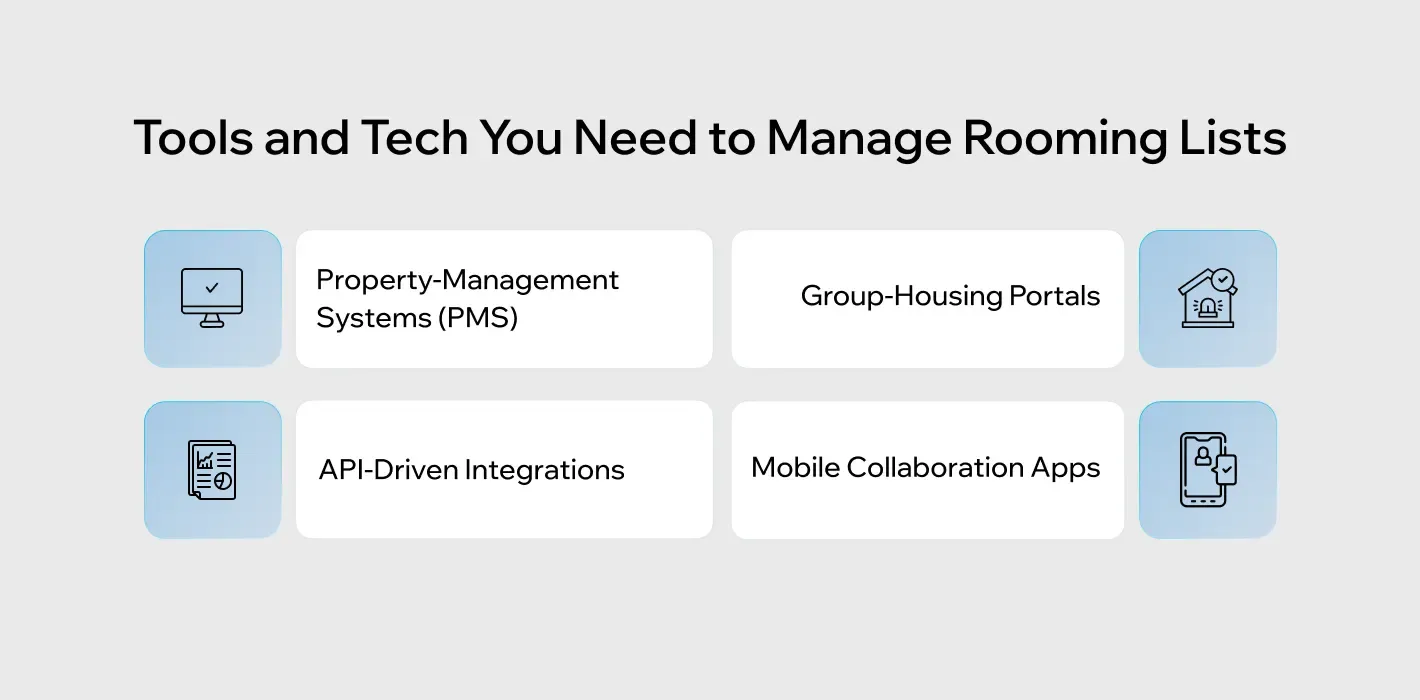
Property‑Management Systems (PMS): Most modern PMS solutions accept CSV or Excel imports, auto‑matching column headings to internal fields. They also timestamp changes, ensuring an audit trail for dispute resolution.
Group‑Housing Portals: Stand‑alone portals let planners upload, revise, and freeze rooming lists through a web dashboard that feeds the hotel's PMS in real time. Automatic prompts remind planners of looming deadlines, drastically reducing "name dump" headaches the night before arrival.
API‑Driven Integrations: Open APIs pull guest data straight from registration forms or corporate HR systems, eliminating manual entry. Loyalty details, seating preferences, and emergency contacts flow seamlessly into the reservation profile.
Mobile Collaboration Apps: Hotel teams (e.g., on WhatsApp or Slack) can connect webhook notifications that announce list changes in dedicated channels. The banquet team learns about a new vegan attendee the moment the planner hits "save."
With these technologies, the rooming list transforms from static paperwork into a living, usable data. Updates appear across departments, staff spend less time chasing emails, and guests receive a top-tier personalized experience.
Mastering rooming lists demands both process discipline and hospitality finesse. Here are the last power tricks we can give to make things smoother for you:
1. Standardize Templates - Use one approved rooming list format across the hotel to avoid import errors and confusion when loading data into your system.
2. Communicate Deadlines Early - Set clear deadlines for initial and final lists in the contract, and send reminders ahead of time so nothing is missed.
3. Validate Data on Arrival - Check the list as soon as you receive it for duplicates, date errors, and payment mismatches to prevent issues later.
4. Use Real-Time Collaboration Tools - Work from one shared, live version of the list instead of multiple emailed copies. One source of truth means fewer mistakes.
5. Train Teams Across Departments - Make sure all departments understand rooming list terms and how to read the data correctly to avoid misinterpretation.
6. Review After Checkout - Compare the final rooming list with occupancy and billing records to confirm no-shows, upgrades, and complimentary nights.
7. Protect Guest Information - As we know, security is above all. Use secure systems, limit access, and safeguard guest data to maintain trust and meet privacy expectations.
Now you've got the full tool kit to make perfect rooming lists for your hotel, and use them in your best interest.

Content Manager
Anush Sargsyan is a content manager specializing in B2B content about OTT streaming technologies and digital media innovation. She creates informative, engaging content on video delivery, OTT monetization, and modern media technologies. The goal is to help readers easily understand complex ideas. Her writing is the bridge between technical detail and practical insight, making advanced concepts accessible for both industry professionals and general audiences.