February 19, 2026
Every hotelier wants to maximize their revenue and sell as many rooms as possible.
That’s the reason hotels adopt an overbooking strategy to get the most out of each available room and avoid losing money if guests decide not to arrive. But what exactly is overbooking and how does this strategy work?
At first, it seems like a promising technique to boost revenue and meet all the expected targets. However, a poor hotel overbooking strategy can lead to major issues if both guests booking the same room show up. The results? Disappointment, dissatisfaction, bad reviews, and the inevitable consequences that those bad reviews can bring.
But when done strategically, hotel overbooking can yield positive rewards for your business.
In this article, we’ll explore what hotel overbooking is, its benefits, risks, and challenges, along with the best overbooking strategies to maximize its efficiency.
Hotel overbooking, or double booking, is a calculated strategy that many hotels use to maximize occupancy and revenue.
In other words, a hotel sells more rooms than it has available for a given night. Revenue managers employ this tactic consciously to cover potential cancellations and no-shows.
While accidental overbooking is a result of system errors, intentional overbooking is a calculated business decision. Hospitality Sales & Marketing Association International (HSMAI) research estimates that the average hotel cancellation rate is between 20% and 40%.
Without overbooking, this would result in significant revenue losses. Hotels oversell to reduce financial losses incurred from unoccupied rooms and maximize revenue. Cancellations and no-shows happen often, giving hotels little time to rebook.
By overbooking, hotels aim to have guests on "standby" to fill those rooms, ensuring optimal occupancy rates. This approach is particularly useful during peak seasons when demand is high. Overbooking also allows hotels to maintain competitive pricing on online travel agencies (OTAs).
Hotel overbooking is a strategic tool that helps hotels maintain high occupancy rates, minimize revenue losses, and optimize operations. While it may seem risky, when carefully managed, overbooking can drive profitability and efficiency. Let’s explore the key advantages and how leading hotels successfully implement this approach.
A room that stays empty means lost revenue. By overbooking, hotels can make up for expected cancellations, ensuring higher room occupancy and maximizing revenue. This practice is well-suited for peak seasons when demand is high. During peak seasons, overbooking can be especially profitable. If a hotel expects a 15% cancellation rate, overbooking by 10-12% ensures the maximum number of rooms remain occupied.
No-shows and late cancellations harm business operations and bottom-line performance. Overbooking mitigates these challenges by ensuring that rooms, which might otherwise stay empty, get booked. According to one study, up to 40% of on-the-books revenue is lost to cancellations, highlighting the importance of overbooking strategies. For instance, research indicates that no-shows cost the UK hospitality industry an estimated £17.6 billion annually in lost sales, with one in seven consumers admitting to not turning up for a reservation.
Maximizing occupancy enables improved management of all aspects of the business - everything from personnel to hotel amenities - which contributes to more efficient operations and lower costs. In contrast, hoteliers can make the most of their housekeeping schedules, food and beverage offerings, and other operational functions when their hotels run full while doing so in an efficient manner.
By overbooking, hotels can use dynamic pricing and prefer high-value bookings, thus optimizing total revenue. Hotels can adjust their rates and overbooking accordingly by analyzing booking patterns, monitoring demand fluctuations, and adjusting their rate accordingly.
During high-demand periods, overbooking enables hotels to prioritize premium guests, such as loyalty members, long-stay travelers, or those booking directly, ensuring the best experience for their most valuable customers. This approach fosters guest loyalty and enhances the hotel's reputation.
While hotel overbooking offers potential advantages, it's crucial to consider the risks and challenges when developing your strategy.
When guests are turned away due to overbooking, it can result in frustration, negative guest feedback and online reviews, and a damaged reputation for the hotels. In the age of social media, one bad encounter can go viral, driving away new guests. The fine line between hotel overbooking and guest satisfaction is crucial to avoid such pitfalls.
Adding to the challenge, managing hotel overbooking scenarios demands rapid problem-solving and can put a strain on staff, with service lapses as a possible consequence. Front desk staff should be trained to diplomatically deal with overbooking, making sure displaced guests are satisfactorily compensated.
The cost of accommodating overbooked guests, which may include covering expenses for alternate lodging, transportation, and other compensation, takes a toll on profit margins. Given these costly consequences, overbooking should never be viewed solely as a revenue opportunity to extract additional profit from a captive market.
In some jurisdictions, there are restrictions on overbooking and consequences for breaking the rules. Shirking these laws can easily turn overbooking into a violation of consumer protection laws, which is the last thing any hotel wants.
To minimize the above mentioned risks, hotels would need to employ smart overbooking strategies. These are listed below.
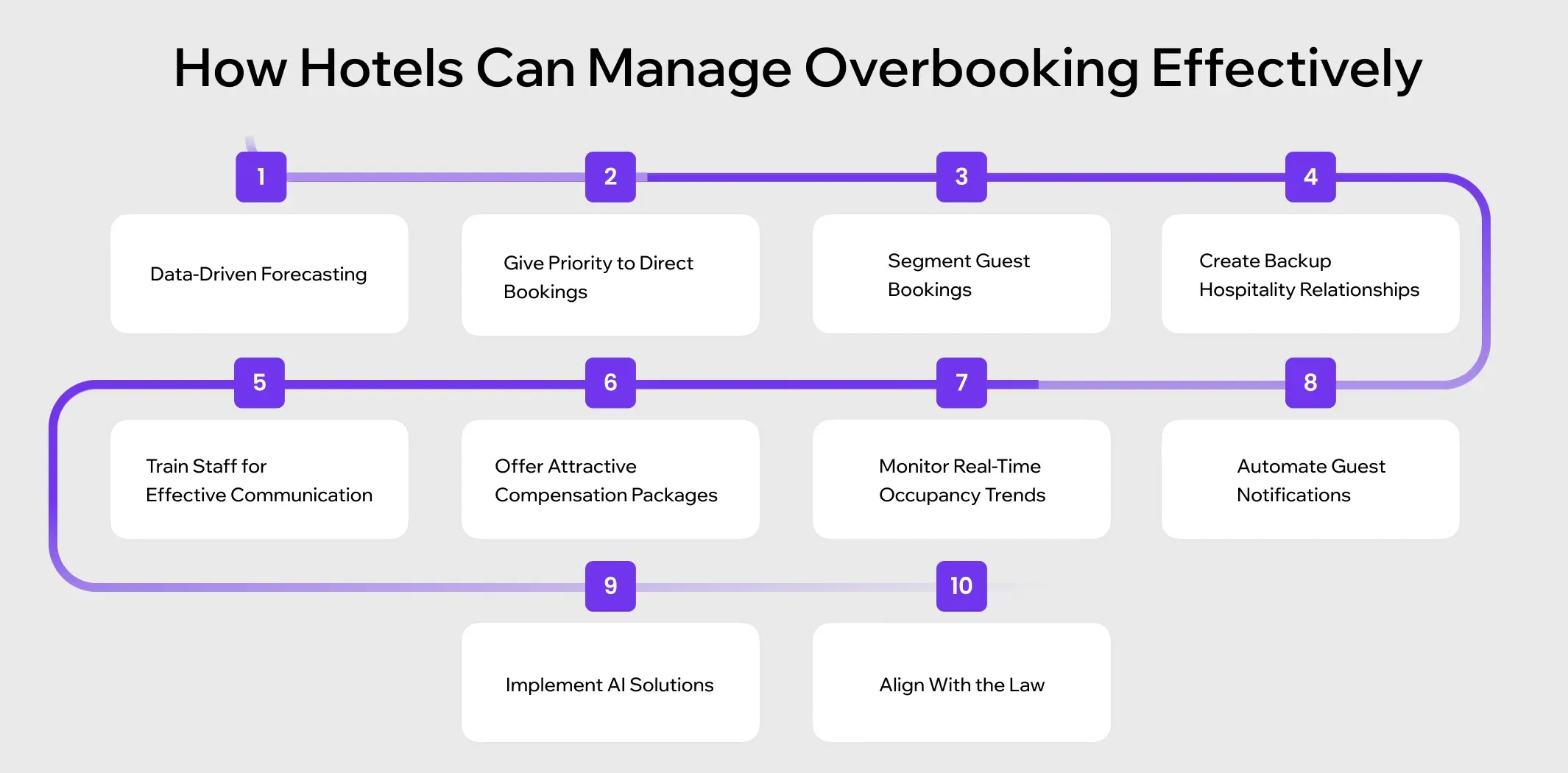
Data-Driven Forecasting: Use historical data, booking trends, and machine learning tools to predict cancellations and no-shows accurately.
Give Priority to Direct Bookings: Guests who book directly through the hotel’s website or loyalty program deserve priority treatment in order to build trust and customer loyalty.
Segment Guest Bookings: Sort guests by booking source, length of stay, and revenue potential to ensure optimal allocation decisions.
Create Backup Hospitality Relationships: Build partnerships with hotels near your venue to ensure a clean and timely transfer of guests in case of overbooking incidents.
Train Staff for Effective Communication: Provide employees with scripts and guidelines for managing overbooking scenarios in a professional and empathetic manner.
Offer Attractive Compensation Packages: If you make mistakes, a good way to retain your guests is to offer incentives (discounts, a free upgrade, dinner vouchers, etc.).
Monitor Real-Time Occupancy Trends: Adjust overbooking limits dynamically using PMS (Property Management Systems) and revenue management tools.
Automate Guest Notifications: Send automated messages and alerts to keep all guests up-to-date on the status of their rooms or possible relocations or upgrades.
Implement AI Solutions: Deploy AI-driven hotel technology to process guest booking trends and enhance overbooking methodologies effectively.
Align With the Law: To remain compliant, you need to stay aware of consumer protection laws in your region before implementing an overbooking strategy.
Technology is an essential tool in effective overbooking management. Property management systems (PMS) and hotel booking engines offer the foundation for accurate forecasting, inventory management, and guest communications.
PMS systems and solutions like HotelSmarters’ middleware platform integrate different operations of the hotel, from reservations and inventory to guest information. This allows for real-time updates on the availability of rooms and the data needed to analyze booking habits and cancellation rates.
These are the websites that enable online booking for hotels and are the bridge between distribution channels and hotels. They enable hotels to manage booking inventory across platforms and analyze booking trends and customer behavior.
Advanced analytics tools can assist hotels in forecasting cancellations and no-shows more accurately. Such tools can identify optimal overbooking strategies and learn how to avoid value walks by using historical data and trends.
Managing inventory across multiple booking channels can be a foolproof way to prevent unintentional hotel overbooking. Channel management software offers room availability in real-time, allowing for increased adjustments to take place, preventing any discrepancies or overbookings.
Here is where HotelSmarters comes into play - a centralized platform that integrates multiple hotel systems to streamline operations. It seamlessly connects Property Management Systems (PMS), booking engines, and guest communication tools, ensuring smooth data flow across all channels.
By reducing manual errors and improving efficiency, HotelSmarters helps hoteliers optimize occupancy management, enhance guest experiences, and make more informed decisions.
Hotel overbooking, when properly executed, is a high-reward strategy that optimizes both revenue and operational efficiency. But careful planning, real-time monitoring , and robust guest relations are needed to ensure they don't end up feeling frustrated.
Data analytics, direct bookings, and technology investments have become the pillars of successful overbooking. By striking a balance between revenue goals and guest satisfaction, hotels can convert overbooking from a liability into a competitive advantage.
As the hospitality industry evolves, data-driven decision-making will continue to shape how hotels manage occupancy. Overbooking, when handled strategically, can be an essential tool for boosting profitability without compromising guest trust.
HotelSmarters provides smart booking solutions that help hotels manage occupancy, reduce risks, and maximize revenue through AI-powered insights and real-time monitoring tools.
Contact us to explore how our innovative solutions can transform your booking strategy and guest experience.

Product Owner
Andranik is a Product Owner specializing in OTT, IPTV, and FAST technologies at inoRain. He leads the development of scalable, end-to-end streaming solutions that enhance video delivery and monetization. His work bridges technical innovation with real business impact, helping platforms and the hospitality sector optimize performance, user experience, and operational efficiency.